
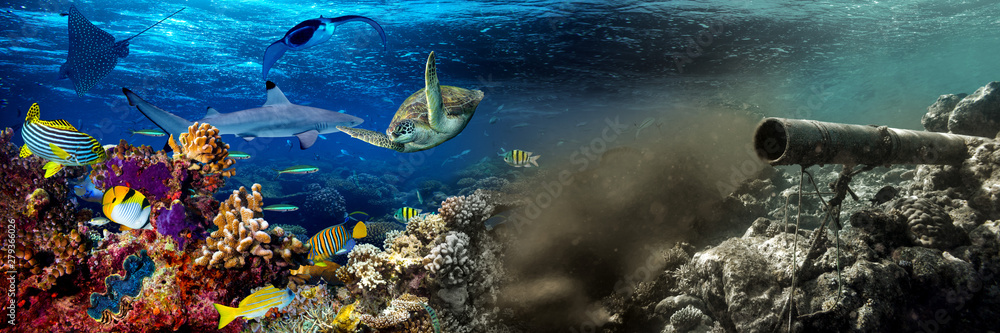
The ocean covers approximately 70% of the surface of Earth, and a part of the life-support system of our planet is in the ocean. It governs many climate factors as well as upholds diverse marine biodiversity levels, feeds multiple billions adequately, and affects the entire global economy greatly. This vital ecosystem now faces a great deal of unprecedented pressure from human activities in the present day: overfishing, and plastic and chemical pollution, as well as habitat destruction, together with climate change have pushed the marine systems toward that tipping point.
Initiatives revolutionary in their nature, as well as global in their scope, must address those issues. It will then be possible for addressing most of the great challenges in the 21st century.
Are there any plans for monitoring and reporting the status on each country?
The 2030 Agenda for Sustainable Development, adopted by all United Nations Member States in 2015, presents a transformative plan of action centered around 17 Sustainable Development Goals (SDGs). These goals represent a global consensus on the most critical challenges facing humanity and the planet, encompassing areas such as poverty eradication, hunger elimination, good health and well-being, quality education, gender equality, and climate action. The SDGs serve as a blueprint for a more resilient and prosperous world, offering a roadmap to navigate the complex and interconnected global crises of our time. Monitoring the progress towards these ambitious goals is paramount, and the United Nations Sustainable Development Goals Report 2024 stands as the key official document in this endeavor. This annual report, meticulously prepared by the UN Department of Economic and Social Affairs (DESA) in collaboration with over 50 international and regional agencies, relies on the latest available data and estimates to provide a comprehensive assessment of the world’s trajectory towards achieving the 2030 Agenda.
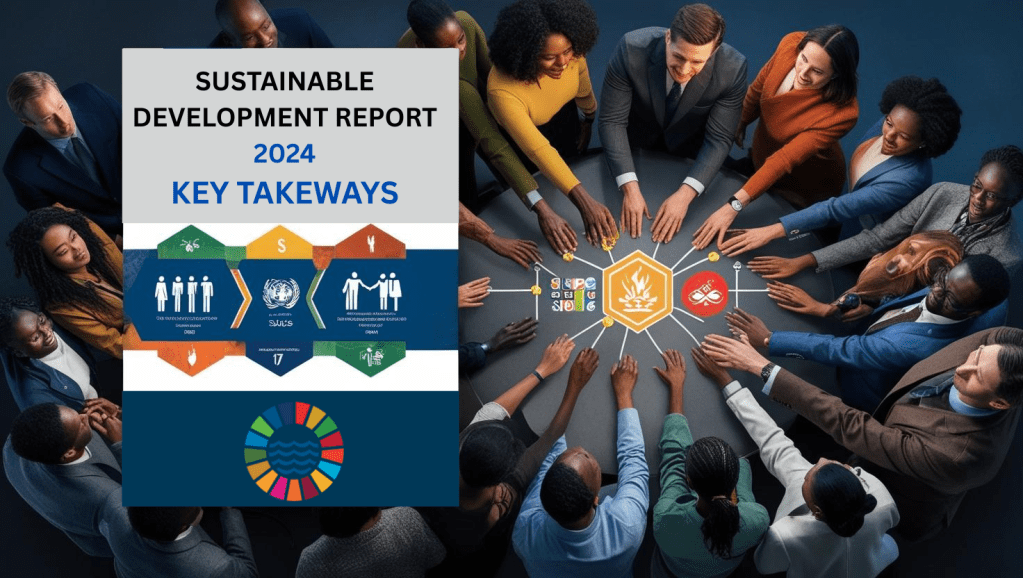
This article aims to distill the critical findings of the SDG Report 2024, highlighting ten significant takeaways and concluding with an urgent call to action for all stakeholders. What is the current state of the current state of these goals as per 2024?
5 x Takeaways from the SDG Report 2024
Overall SDG progress
SDG Report 2024 reveals a deeply concerning reality. Despite early momentum, progress has plateaued or reversed in many areas:
- On average, only 16% of SDG targets are on track for achievement by 2030.
- Nearly half of the targets are exhibiting minimal or moderate progress, while one-third of the SDG targets have either stalled or regressed below the baseline established in 2015.
Significant Setbacks in Key SDGs
- The health of our planet ecosystems is under severe threat, with SDG 14 (Life Below Water) and SDG 15 (Life on Land) both facing significant regression.
- Oceans are grappling with overfishing, pollution, and the impacts of climate change, while global forest area continues to decline, and risks to species are escalating.
- Other SDGs are also off track: The SDG 2 (Zero Hunger) is severely off-track, SDG 11 (Sustainable Cities and Communities) faces major challenges, evidenced by a deepening global slum crisis. While, SDG 16 (Peace, Justice, and Strong Institutions) has witnessed a concerning rise in civilian deaths in armed conflict.
Climate Crisis Intensification
- The year 2023 was recorded as the warmest year on record, with global temperatures nearing the critical threshold of 1.5°C above pre-industrial levels.
- Record-high ocean temperatures have triggered the fourth global coral bleaching event, a clear indicator of accelerating climate disruption.
- Greenhouse gas emissions and atmospheric CO2 concentrations continue their upward trajectory, reaching new record highs.
Data Gaps Hamper Effective Monitoring
- Critical data is still lacking in key areas such as gender equality, climate action, and peace, justice, and strong institutions.
- Reliable, timely, and disaggregated data is crucial for understanding where progress is being made and where efforts need to be intensified.
- Addressing these data gaps through investments in national statistical systems and enhanced data collection efforts is essential for effective monitoring and implementation of the SDGs.
Urgent Need for Financial Investment and Global Cooperation
- More effective partnerships and stronger international cooperation are essential to provide the necessary support to developing countries and ensure that no nation is left behind in the pursuit of sustainable development.
- Reforming the global financial architecture to better support the needs of developing nations is also identified as a critical step.
5 x Areas of Progress
- SDG 3 (Good Health and Well-being): Significant strides have been achieved in reducing global child mortality rates and preventing HIV infections. Increased access to life-saving AIDS treatment has averted millions of deaths.
- SDG 6 (Clean Water and Sanitation): Access to essential services such as water, and sanitation has also improved for many people around the world.
- SDG 4 (Quality Education): In most regions, girls have achieved parity and even surpassed boys in completing schooling at all levels.
- SDG 9 (Industry, Innovation and Infrastructure): Internet access has expanded significantly, connecting a larger portion of the global population.
- SDG 7 (Affordable and Clean Energy): The global capacity for renewable electricity generation is also expanding at an unprecedented rate, offering hope for a transition to cleaner energy systems.
Call for Action
The findings of the SDG Report 2024 serve as a stark reminder that achieving the Sustainable Development Goals by 2030 requires a significant shift in ambition and action.
Governments, must elevate their national ambitions and fully integrate the SDGs into their national policies, development plans, and budgetary allocations. Investing in strengthening national statistical systems is crucial to improve data collection, monitoring, and evidence-based policymaking.
International Organizations, particularly the United Nations, must strengthen international cooperation and provide enhanced support to developing countries through financial assistance, technology transfer, and capacity building. Reforming the global financial architecture to ensure that low-income and lower-middle-income countries have access to affordable long-term capital is more critical than ever. Facilitating knowledge sharing and the dissemination of best practices for SDG implementation will also be crucial.
The upcoming Summit of the Future and other significant conferences in 2025 present vital opportunities to galvanize renewed commitments and accelerate progress towards the SDGs.
Businesses investing in innovative solutions that directly contribute to SDG achievement and ensuring decent work and fair labor practices throughout their value chains are essential contributions.
Individuals and Civil Society Organizations raising awareness about the SDGs, advocating for action from governments and businesses, and making sustainable consumption and lifestyle choices can collectively create a powerful force for change. Holding governments and businesses accountable for their commitments to the 2030 Agenda is also crucial for ensuring progress.
As the Secretary-General of the United Nations, António Guterres, aptly stated:
Now is the time to lift the declarations words off the page, and invest in development at scale like never before.
Conclusion
The UN SDG Report 2024 delivers a sobering assessment of the worlds progress towards achieving the Sustainable Development Goals. The confluence of global crises, widening inequalities, and insufficient action has jeopardized the realization of the 2030 Agenda. However, the SDGs remain a vital roadmap for building a better future for all. If we are to make a change, bold and coordinated action is required.
Protecting the ocean is essential, which underpins climate stability, economic resilience, and food security. SDG 14 is a frontline defense in humanity’s effort to restore ecological balance and build a more sustainable, equitable world. Through strengthened international cooperation, open science, enhanced monitoring, and inclusive financing, we still have a chance to turn the tide.
By acknowledging the urgency of the situation and committing to bold, collective action, as emphasized in the report , we can still strive to achieve the transformative vision of the 2030 Agenda.
In the words of the UN, United we can overcome any challenge and realize the world we want.



 SaveOCEAN
Leave a comment