Read the original full report here
Published by the Arctic Monitoring and Assessment Programme (AMAP), an Arctic Council Working Group, the “Arctic Climate Change Update 2024: Key Trends and Impacts” is a critical assessment of the accelerating climate transformations occurring across the Arctic region. This report, building upon previous assessments and incorporating four additional years of data, highlights unprecedented changes and their far-reaching implications for Arctic ecosystems, Indigenous Peoples, and the global climate system.
Executive Summary
The Arctic is undergoing rapid and profound climate change, warming at a rate significantly faster than the global average. This accelerated warming is driving widespread and often record-breaking changes across the cryosphere (ice and snow), atmosphere, and ocean, leading to an increase in extreme weather events and cascading impacts on both local and global scales. The report underscores the urgency for robust mitigation efforts and continued monitoring, even in the face of current geopolitical challenges.
Key Trends and Impacts:
Accelerated warming
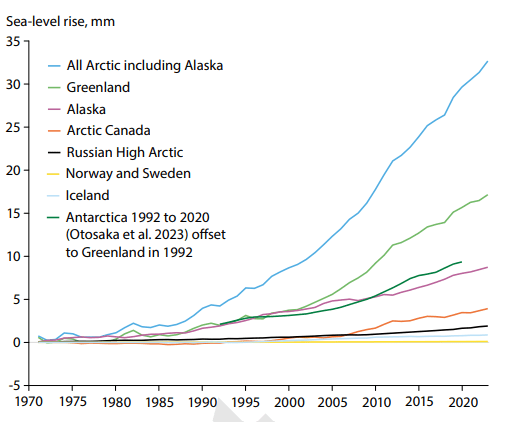
sea-level rise. Source: AMAP, 2024. AMAP Arctic Climate Change Update 2024: Key Trends and Impacts. Arctic Monitoring and Assessment Programme (AMAP), Tromsø, Norway.
- The Arctic is warming approximately three to four times faster than the global average. Arctic annual air temperatures have risen by an alarming 3°C since 1971.
- The greatest warming is observed in the winter months (October to May), particularly in marine environments, due to declining sea ice allowing more heat to escape from the ocean.
Cryosphere Decline (Ice and Snow Loss)
- Sea Ice: Sea-ice extent from 2007–2024 was the lowest in the 44-year satellite record. Projections indicate a nearly ice-free Arctic summer could occur as early as 2040. Reduced sea ice accelerates warming through the ice-albedo feedback.
- Land Ice & Glaciers: Widespread loss of land ice and glaciers is contributing to global sea-level rise.
- Snow Cover: Spring and autumn snow-cover extent have substantially declined, particularly in Eurasia. The melt season is lengthening, and the freeze season is shortening.
- Permafrost Thaw: Permafrost across the Arctic is warming and thawing, with significant implications for infrastructure, ecosystems, and the release of greenhouse gases. The rate of thaw is notably faster in discontinuous permafrost zones.
Wetter Arctic and Hydrological Shifts:
- The Arctic is becoming wetter overall, with an increase in total precipitation and a shift from snowfall to rainfall.
- The surface area receiving daily precipitation has increased, making precipitation both more intense and widespread.
- Freshwater discharge from rivers to the Arctic Ocean increased by 13 percent from 1974 to 2023, indicating an intensification of the Arctic water cycle.
- Lakes and rivers are losing ice rapidly, with later ice-on and earlier ice-off dates.
Ocean Acidification:
- The Arctic Ocean is acidifying three to four times faster than other ocean basins globally, primarily due to reduced sea-ice cover that allows for greater uptake of atmospheric CO2.
- Some regions have already reached conditions that may negatively affect marine life, threatening the livelihoods and food security of Arctic Indigenous Peoples and coastal communities.
Extreme Events and Wildfires:
- Record-breaking extreme weather events have become increasingly common and are often unprecedented in the observational record. These include extreme air and sea-surface temperatures, intense ice melt events (e.g., Svalbard in 2022), and widespread wildfires.
- Wildfires are becoming more intense and frequent across the Arctic, driven by warmer and drier conditions and exacerbated by the expansion of vegetation due to permafrost thaw. The report emphasizes the importance of integrating Indigenous knowledge to understand wildfire ignition sources.
Ecosystem and Societal Impacts:
- “Shrubification” and Greening: The Arctic continues to “green,” with a 13% increase in vegetation greenness since 1982, correlating with rising temperatures and increased precipitation.
- Impacts are profoundly felt by Indigenous Peoples and other Arctic communities, affecting their traditional ways of life, food security, and infrastructure due to permafrost thaw and altered ecosystems.
Arctic-Midlatitude Linkages:
The report continues to explore the intricate connections between Arctic climate changes and mid-latitude weather patterns, with implications for weather systems affecting millions globally. The interdependence of climate change, Arctic amplification, and natural variability is producing new extremes.
Challenges and Recommendations:
- Urgent Need for Mitigation: The report strongly emphasizes the urgent need for global mitigation measures to slow the pace of Arctic climate change and its cascading effects.
- Persistent Monitoring and Research: Continued, robust monitoring and research are critical to understanding the accelerating changes, predicting future trends, and informing adaptation strategies. New technologies like satellites and AI are providing further insights.
- Bridging the Gap Between Science and Policy: While scientific understanding is deepening, the report implicitly highlights the challenge of translating these findings into effective and timely political action, particularly in the current geopolitical climate.
- Indigenous Knowledge Integration: The importance of integrating Indigenous knowledge for a more holistic understanding of Arctic changes, particularly regarding phenomena like wildfires, is underscored.
In conclusion, the AMAP Arctic Climate Change Update 2024 paints a stark picture of an Arctic transforming at an alarming and unprecedented rate. The changes observed are not only reshaping the region but also exert significant influence on global climate systems, underscoring the urgent need for international cooperation and decisive action to address the climate crisis.
SaveOCEAN calls upon you to be part of the solution. Our collective future depends on a healthy ocean. Here’s how we can bridge the gap between aspiration and action:
1. Demand Stronger Governance & Implementation:
- Prioritize Ocean Funding: Call on policymakers to significantly increase funding for SDG 14 (“Life Below Water”) and other ocean conservation initiatives. The ocean cannot be an afterthought in global development.
- Hold Leaders Accountable: Demand that national laws, such as the Magnuson-Stevens Act, the Coral Reef Conservation Act, and Australia’s EPBC Act, are rigorously enforced.
2. Champion Effective and Equitable Marine Protected Areas (MPAs)
Support initiatives that ensure MPAs are not just designated but are effectively managed, monitored, and enforced, truly eliminating damaging activities like bottom trawling within their boundaries.
- Advocate for “30×30” with Integrity: Push for the global 30×30 target to protect 30% of the world’s oceans by 2030, but emphasize that this must be achieved through high-quality, fully protected MPAs that genuinely contribute to biodiversity.
- Community-Led Conservation: Demand that MPA establishment and management prioritize the rights and livelihoods of Indigenous Peoples and local fishing communities.
3. Combat Pollution, Especially Plastic:
- Reduce, Reuse, Recycle, Refuse: Prioritizing reusable alternatives and proper recycling.
- Support the Global Plastic Pollution Treaty: Advocate for a strong, legally binding treaty that addresses the entire lifecycle of plastics.
- Clean Up Our Coasts and Waterways: Participate in local beach cleanups and support organizations working to remove plastic and other pollutants from marine environments.
4. Address Climate Change – Protect Our Polar Regions, Protect Our Oceans:
- Demand Ambitious Climate Action: Push for stronger national and international commitments to reduce greenhouse gas emissions.
- Support Renewable Energy: Advocate for a rapid transition to renewable energy sources.
- Understand the Arctic Link: Recognize that Arctic climate change is not distant; its impacts on sea level, ocean currents, and extreme weather events directly affect coastal communities worldwide.
5. Foster Collaboration and Integrate Knowledge:
- Support Scientific Research: Advocate for continued funding and international collaboration in marine science, including Arctic monitoring, to better understand ocean changes and inform solutions.
- Value Indigenous Knowledge: Ensure that the invaluable traditional knowledge of Indigenous Peoples is respected, integrated, and empowered in ocean governance and conservation strategies.
- Unite for the Ocean: Join “SaveOCEAN.net” and connect with like-minded individuals and organizations. Collective action, sustained financial commitments, and a willingness to prioritize collective ocean health over narrow interests are paramount.
The time for mere aspiration is over. The time for decisive, collective action is now.
Join “Save Ocean” and become a guardian of our most precious resource – the life-sustaining ocean.
 SaveOCEAN
Leave a comment