

🌊 Day # 2 at 2025 UN Ocean Conference- Ocean Action Panel 4 – UNOC 2025 (Nice, France)
Preventing and Significantly Reducing Marine Pollution from Land-Based Sources
At the 2025 UN Ocean Conference, Ocean Action Panel 4 opened with a sobering truth: the world has missed the 2025 target to reduce marine pollution under SDG 14.1. But it also brought new hope rooted in ambitious commitments and bold innovations.
This article highlights key insights from the panel discussion.
🇩🇪 Germany: Leading with Urgency
Carsten Schneider, Germany’s Minister for Environment and Climate Action, spotlighted two priorities:
- A Global Plastic Agreement: A legally binding pact for all nations is critical. Negotiations must conclude this August 2025 in Geneva. The agreement must:
- Cover the entire lifecycle of plastics
- Create legal certainty for producers
- Enforce manufacturer responsibility
- Include a review mechanism for adjustments
- Financial support: Germany’s leadership began in 2019 with a significant financial support €82M support fund across 25 countries and this is to be continuing through 2026 and 2028.
- Legacy Munitions in Our Oceans:
Germany is investing €1 billion to recover and clear underwater munitions from Germany, North Sea & Baltic regional seas. A new offshore clearance tech platform will help scale this effort, illustrating that innovation and cooperation are key to restoring marine ecosystems.
“We can only succeed if we work together.” – Carsten Schneider
🇲🇷 Mauritania: Backing the Plastic Treaty
Messouda Baham, Mauritania’s Minister for the Environment strongly endorsed the global plastic agreement and called on all nations to sign it in Geneva. The shared sentiment: global pollution needs global accountability.
🌐 UNEP’s Wake-Up Call
Inger Andersen, UNEP Executive Director and Under-Secretary-General of the United Nations, reminded us of a hard truth:
“The oceans are this innocence and they are a receptable of our trash.”
She highlighted few key statistics:
🔹 80% of marine pollution comes from land coming especially from mismanaged wastewater and factory runoff.
🔹 Only 9% of the 430 million tonnes of plastic produced annually is recycled.
It has been progress also for example with the help of the IMO in the early 70s with the marine pollution treaty and the 17 regional seas conventions where some work has been done but still a lot of work remaining.
UNEP is negotiating a new global panel to tackle chemical and waste pollution, aiming to close loopholes in the 1970s marine treaties and build on the 17 regional seas conventions.
Call for need a lifecycle approach, rethink, redesign, and what other alternatives are? There are many innovations as new type of plastic leaving no toxic microplastics behind.
🇪🇺 EU: Toward a Water-Resilient Future
The European Commissioner for Environment, Water Resilience and a Competitive Circular Economy, Jessika Roswall reinforced the need to unify all ocean-related policies and work together. EU has focused in creating the European Ocean Pact in order to tackle this situation with a clean sense of direction and more EU has signed a high ambition coalition declaration acknowledging quiet ocean.
“In order to protect seas need to fight pollution at sources.” says Jessika Roswall.
Despite decades of regulations, only 27% of Europe’s surface waters meet good chemical status. To reverse this:
- The EU Water Resilience Strategy is now in place
- €50 billion in EU Investment Bank funding will restore water systems over 3 years
Action priorities:
- Boosting circular economies
- Supporting biobased plastic alternatives
- Reinforcing regional cooperation through sea conventions
Seeing the Ocean Clearly: The Data Crisis Beneath the Waves
Without robust data governance, we are effectively navigating the ocean blindfolded. Countries must prioritize national systems that institutionalize ocean data collection—creating permanent, accessible datasets to track changes over time. We need atmospheric and satellite-based observations, not just coastal data. As one expert aptly put it:
“Without data, we are blind—unable to detect the trends, let alone respond to them.” says Professor Alexander Turra
🧴 A Sea of Plastic: From Rivers to the Deep
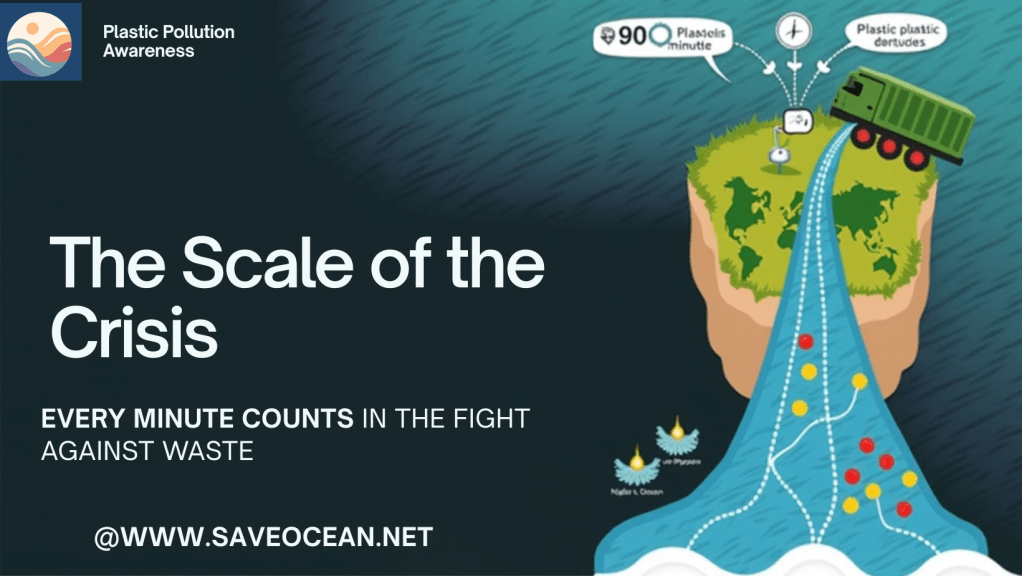
In 2008, the world discovered what has since been called a “plastic continent.” A decade later, in 2019, science confirmed that rivers are major arteries of plastic pollution. And nowadays, the numbers are staggering:
900 million plastic particles flow through some rivers every second.
Even more alarming, new technologies now detect microplastics thousands of times smaller than the human eye can see and the impact of these are huge. These particles silently alter marine ecosystems. They are not just waste they are climate-active pollutants. It’s now estimated that plastic pollution contributes up to 4% of global climate change impacts.
🧪 Cleanup ≠ Cure
Yes, we can pick up plastic—but science shows that cleanup efforts alone barely scratch the surface. In some regions, people are exposed to toxic chemicals leaching from consumer plastics, further endangering human and marine health.
🔄 The Hard Truth on Recycling
We’re far behind:
- Only 13% of global recycling targets for 2050 are considered to be on track.
- Ambitious reduction goals, like cutting plastic by 75%, are likely unachievable especially since plastic production has doubled in recent years.
⚠️ The Message Is Clear:
We are running out of time—but not out of solutions. We know the sources, the science, and the systems that work. What we need now is:
✔️ Mainstream plastic-use reduction into every government ministry and economic sector
✔️ Redesign plastic at its source—phase out toxic ingredients
✔️ A commitment to innovation and accountability
✔️ Redesign plastic at its source—phase out toxic ingredients
✔️ Stop thinking in silos—think system-wide
🌍 Let’s End Pollution of all kinds at the Source—Together.
Sign the Treaty. Fund the Solutions. Rethink the System.
Because the ocean doesn’t need more promises. It needs protection.
This is not just about oceans. It’s about climate, health, economy, and justice. A whole-of-society shift is the only way to secure a clean, resilient ocean for future generations.
🔊 Let’s demand bold ocean policies backed by data, not delay.
🔁 Share this.
📣 Speak up.
🤝 Act together.
Because what we do on land is drowning our ocean—and there’s no lifeboat big enough for silence.
#UNOC2025 #MarinePollution #PlasticTreaty #OceanAction #SDG14 #CircularEconomy #EUBlueDeal #UNEP #WaterResilience
 SaveOCEAN
Leave a comment