
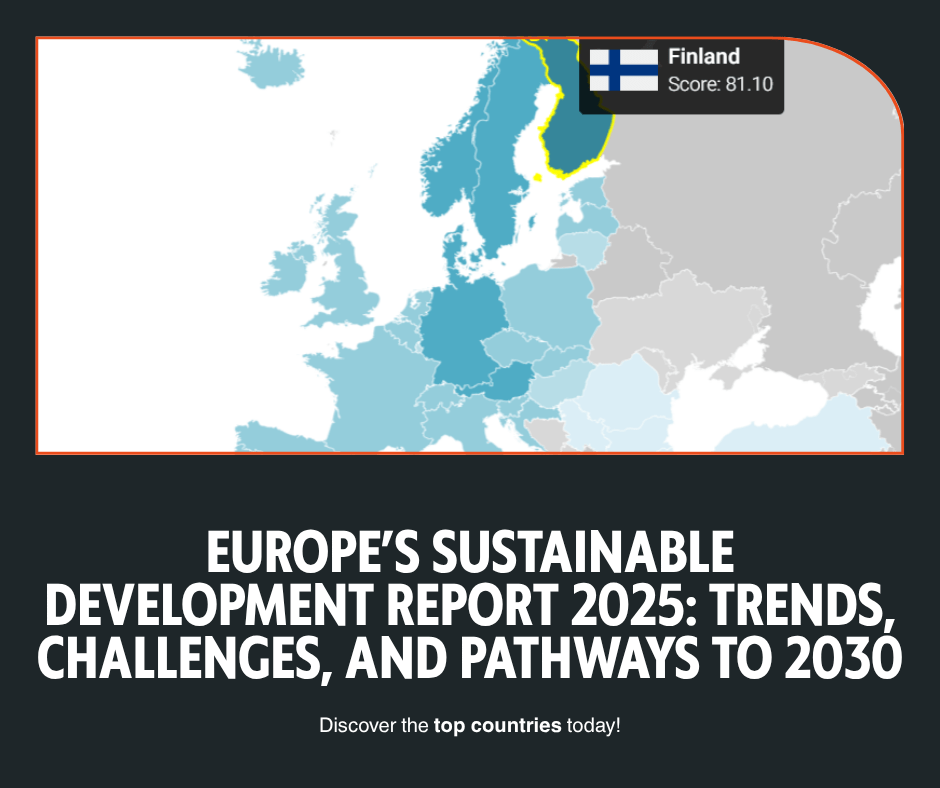
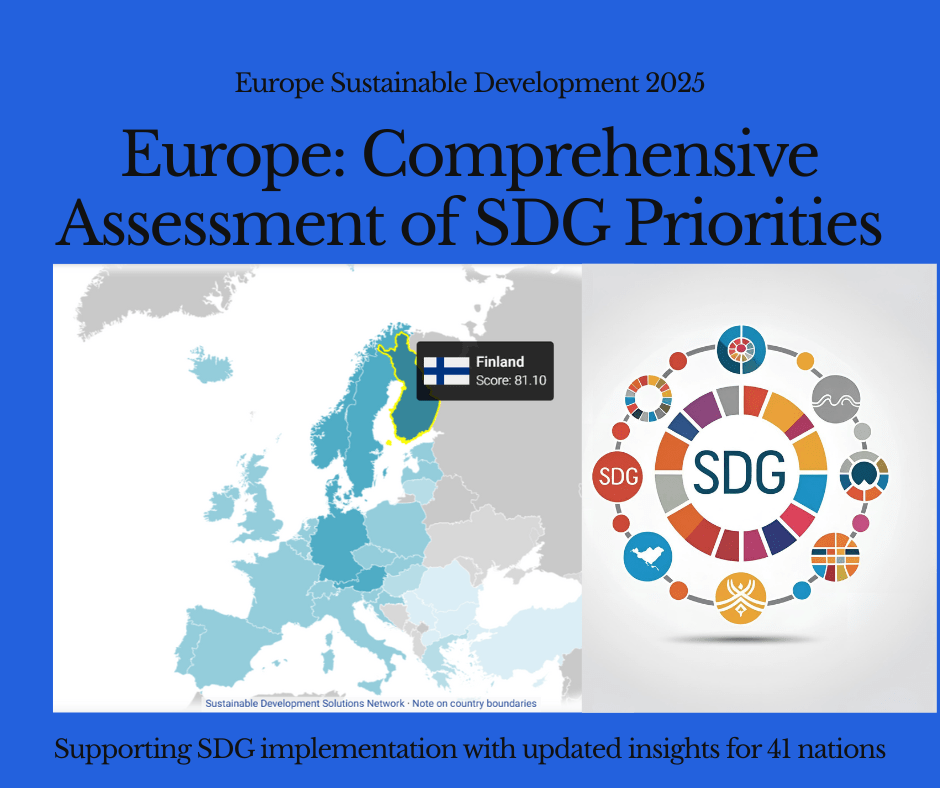
The Europe Sustainable Development Report 2025 (ESDR2025) represents the sixth comprehensive assessment of Sustainable Development Goal (SDG) priorities for the European Union (EU), European Free Trade Agreement (EFTA) countries, the United Kingdom, and candidate countries. This edition, encompassing 41 individual European nations as following: 27 EU member states, 9 Candidate countries, 4 countries in the European Free Trade Agreement (EFTA) and the United Kingdom. By doing so it aims to bolster the implementation of the SDGs and the 2030 Agenda in Europe through updated narrative insights and a robust data framework.
This report aligns with the broader Sustainable Development Report (SDR) 2025, which commemorates the 10th anniversary of the SDGs. The overarching focus of this year’s SDR is “Financing Sustainable Development to 2030 and Mid-Century,” signaling a critical recognition that financial mechanisms represent a core impediment to progress, thereby shifting the emphasis from mere policy commitment to tangible resource mobilization.
Key Trends in European SDG Performance
Europe continues to hold a leading position in global SDG performance, with 19 of the top 20 countries in the SDG Index being European.
Finland, for the fifth consecutive year, ranks first globally, followed closely by Denmark, Sweden, Austria, and Norway. Despite this prominent standing, a closer examination reveals that this leadership is relative rather than indicative of robust, consistent progress towards the 2030 targets. Yet the SDG dashboards show that even these countries face major challenges (red dashboard rating) in achieving at least two goals.
The average SDG Index score for the EU in 2025 stands at 72.8 percent. However, the pace of SDG achievement within the European Union has notably decelerated. Progress between 2020 and 2023 was more than two times slower, with an increase of only 0.8 points, compared to the 1.9 points gained between 2016 and 2019.
In some advanced European regions, such as Western and Northern Europe, SDG performance has even slightly declined since 2020, primarily due to worsening trends in socio-economic goals. This deceleration implies that Europe’s initial advantage is being eroded, and its current trajectory is insufficient for full SDG attainment. Globally, the overall SDG progress has stalled, with none of the 17 Global Goals on track, and only 17% of the targets projected to be achieved by 2030.
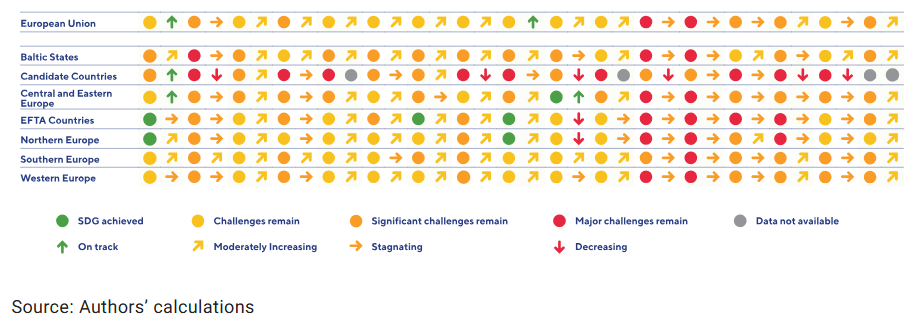
Indicators showing the most progress since 2015:
- Individuals that use the internet to make appointments with a practitioner (%)
- Household with broadband access (%)
- Positions held by women in senior management positions (%)
- Gross disposable income (Euro / capita)
- Unemployment Rate (% labour force)
Indicators showing the worst regression since 2015:
- Variation in mathematics performance explained by students’ socio-economic status (%)
- Underachievers in mathematics (% of population aged 15)
- PISA score (worst 0-600 best)
- Press Freedom Index (worst 0-100 best)
- Gap in self-reported health, by income (p.p.)
Table 1: European SDG Index Performance Overview (2015-2025) summary
| Metric | Value/Trend |
| Pace of SDG Progress in EU (2020-2023) | 72.8% |
| Top 5 European Countries (2025 Rank & Score) | 1. Finland (87.02), 2. Sweden (85.74), 3. Denmark (85.26), 4. Germany (83.67), 5. France (83.14) |
| European Countries in Top 20 Globally | 19 out of 20 |
| Countries at bottom of LNOB Index (examples) | Baltic States, Central and Eastern European countries |
| Global SDG Targets on Track (by 2030) | Only 17 |
The “Leave-No-One-Behind” (LNOB) Principle
Northern European countries generally achieve the highest scores on the 2025 LNOB Index, a reflection of their low income inequality and limited material deprivation. Conversely, persistent within-country inequalities are evident in the Baltic States and Central and Eastern European countries, which occupy the lower ranks of the LNOB Index.
A concerning observation is the regression on the LNOB principle, particularly evident in declining trends for poverty and material deprivation, even within leading Western and Northern European countries since 2020. This reversal points to a fundamental vulnerability, suggesting that recent global shocks, such as inflation and geopolitical tensions, are disproportionately affecting the most vulnerable populations within Europe.

In summary the Northern Europe excel with a score of 85, indicating strong equity and inclusion in contrary, the candidate countries show a significant gap with a score of only 50.
Major Challenges and Areas for Improvement
Despite Europe’s relative leadership in SDG performance, several critical challenges persist, demanding urgent attention and strategic intervention. These areas of improvement are fundamental to achieving the 2030 Agenda.
Environmental and Biodiversity Goals (SDG 2, SDG 12-15)
Significant challenges remain concerning environmental and biodiversity goals, particularly those related to sustainable food and land systems (SDG 2, SDGs 12–15). Globally, SDG 2 (Zero Hunger), SDG 14 (Life Below Water), and SDG 15 (Life on Land) are notably off track, facing major hurdles and showing minimal or no progress. This indicates a systemic issue in addressing ecological sustainability.
Negative International Spillovers
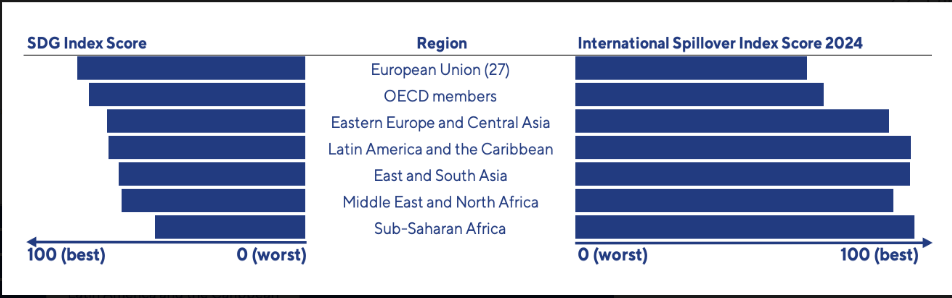
A notable contradiction arises from Europe’s strong SDG performance alongside its substantial negative international spillovers, primarily stemming from unsustainable consumption and exports. These spillovers are largely driven by unsustainable supply chains that contribute to deforestation and other adverse environmental and social impacts, serving the consumption needs of EU and OECD countries. This dynamic implies that Europe’s current sustainability model, reliant on global supply chains, is not inherently global and necessitates a fundamental re-evaluation of its consumption-driven economic approach.
Convergence Gaps and Institutional Weaknesses
Large disparities and a slow pace of convergence in SDG outcomes are observed across European countries, particularly concerning SDG 9 (Industry, Innovation and Infrastructure). Furthermore, slow progress and even reversals are evident in some indicators under SDG 16 (Peace, Justice and Strong Institutions) and SDG 17 (Partnerships for the Goals). The observed stagnation and even reversals in SDG 16 and SDG 17, coupled with persistent environmental challenges across SDGs 2, 12-15, indicate a causal relationship. Weakened governance structures, declining press freedom, and increasing corruption can directly impede the effective implementation and enforcement of environmental regulations and sustainable practices. This creates a cycle where institutional deficiencies exacerbate ecological degradation, making it more challenging to achieve broad sustainable development objectives.
Recommendations
Launch a “European Deal for the Future”:
- Raise public and private investment (e.g. MFF 2028–35) in clean energy, digital infrastructure, and social safety nets.
- Integrate SDGs explicitly into the European Semester and Horizon Europe funding mechanisms.
Reinforce the Leave-No-One-Behind Agenda:
- Prioritize affordable housing, disability employment, and universal access to essential services.
- Establish a structural LNOB monitoring body within the EU with annual progress reviews.
Bridge Regional Gaps:
- Use Cohesion Policy and targeted funds to aid Southern, Baltic, Central/Eastern, and Candidate regions.
- Facilitate technology transfer, R&D partnerships, and shared infrastructure to reduce convergence timelines.
Curb Negative Global Spillovers:
- Expand CBAM-like tools to include deforestation-linked imports, plastics, and water-intensive goods.
- Support multilateral trade and investment reforms (via WTO, UNCTAD) to embed sustainability.
- Dedicate a share of CBAM revenues to finance sustainable production in developing countries.
Invest in Innovation & Education:
- Harmonize R&D incentives across Europe to support green and digital technology.
- Enhance STEM education and close performance gaps revealed by PISA and TIMSS results.
Champion SDG Diplomacy & Global Finance Reform:
- Build on FFD4 (Finance for Development) to reform the global financial architecture and increase ODA.
- Promote “Green Deal Diplomacy” in cooperation with Global South and global SDG mechanisms.
Institutionalize Civil Society Engagement:
- Create a permanent EU-level mechanism (e.g., within EESC) for structured SDG dialogue with youth, NGOs, and businesses.
- Publish a second EU Voluntary National Review ahead of 2027 to reinforce EU leadership.
Conclusion
While Europe remains a global SDG frontrunner, the 2025 report is a clear warning: reversing gains in social equity and environmental stewardship threatens long-term sustainability. Significant and targeted action—across investment, regional cohesion, external impact, and inclusive governance—is essential.
This is Europe’s moment to lead the global SDG agenda by turning structural disparities into strength, both within its borders and across the world.
Inspiring quotes:
“Europe cannot lead the SDG transformation globally if it cannot achieve convergence and leave no one behind within its own borders.” – ESDR 2025 Report
“Without strong, inclusive public services, SDG progress will remain a privilege, not a promise.” – SDSN Europe
The tide has not finished turning. But it will take every current, every country, and every citizen rowing in the same direction.” — SDG 14 Ocean Conference, 2025
 SaveOCEAN
Leave a comment