
The ocean pulses with a slow, steady rhythm, much like the inhale and exhale of a living being. While forests, particularly the Amazon, are often considered the lungs of the planet, the true lungs lie beneath the surface of the sea. The ocean produces more than half of the oxygen breathed, not through marine animals or waves, but through billions of microscopic organisms called phytoplankton. These tiny, floating plants photosynthesize in sunlight, exhaling oxygen into the air above, meaning that every second breath taken likely originates from the sea.
Beyond oxygen production, the ocean serves as Earth’s greatest climate regulator. It absorbs approximately 90% of the excess heat trapped by greenhouse gases, functioning as a planetary thermostat that cools when temperatures rise and releases warmth when the world gets cold. Without the ocean’s moderating influence, global temperatures would have already rendered much of the planet uninhabitable. Furthermore, the ocean stores more carbon than all the world’s rainforests combined, capturing billions of tons of carbon dioxide deep below its surface through natural cycles and marine life, thereby buying humanity time in the struggle against a changing climate.
Beneath the surface lies a world more alien and vibrant than rainforests, deserts, or mountain peaks. Scientists have identified over 230,000 marine species, though the true number likely extends into the millions.
The significance lies not just in the number of species but in their intricate interconnectedness. A coral reef the size of a parking lot can shelter thousands of interconnected lives, from clownfish and algae to reef sharks and sea cucumbers. Removing even one component can tip the delicate balance.
You may live far from the sea but make no mistake: the ocean lives in you.
Every second breath you take comes from some tiny ocean plants creating oxygen. The ocean regulates our climate, absorbs nearly a third of our carbon emissions, and feeds over 3 billion people. It connects continents through currents and trade. It hums with the songs of whales, pulses with the energy of tides, and hides mysteries we have yet to discover.
Yet for all it gives, we have taken too much and side effects are to be felt and seen all over the world.

Overview of Most known Ocean Threats
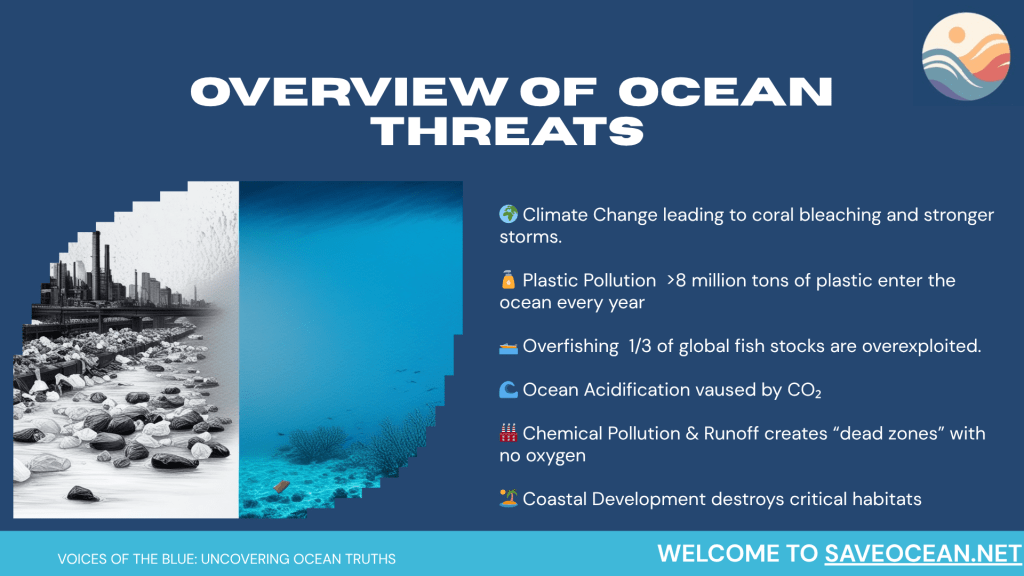
- Plastic pollution
- 900 million plastic particles flow through some rivers every second
- It’s now estimated that plastic pollution contributes up to 4% of global climate change impacts.
- The Hard Truth on Recycling:
- Only 9% of the 430 million tones of plastic produced annually is recycled.
- Only 13% of global recycling targets for 2050 are considered to be on track.
- Ambitious reduction goals, like cutting plastic by 75%, are likely unachievable especially since plastic production has doubled in recent years.
- Overfishing
- Over the past half-century, the number of overfished stocks worldwide has tripled, with a full one-third of the world’s assessed fisheries currently pushed beyond their biological limits.
- Globally, a staggering 37.7 % of marine exploited marine fish stocks are now overfished, a stark increase from less than 10 % in 1970s.Globally, a staggering 37.7 % of marine exploited marine fish stocks are now overfished, a stark increase from less than 10 % in 1970s.
- Ocean Acidification
- Rising temperatures and increasing CO2 emissions.
- Ocean surface pH has dropped from 8.11 in 1985 to 8.04 by 2023–2024—a decline of ~0.07 pH units or around 20–30% increase in acidity compared to pre-industrial levels.
- Warming-induced changes and weakened circulation have reduced the ocean’s carbon sink capacity by about 13% over the past two decades.
- Up to 60% of subsurface ocean areas are close to or beyond safe saturation levels for marine calcifies. This jeopardizes the productivity of entire food chains
- Chemical pollution & Runoff
- 80% of marine pollution comes from land coming especially from mismanaged wastewater and factory runoff.
- Chemical pollution from ships is rising, and it’s largely going unnoticed. Each year, between 9,000 and 20,000 tones of hazardous chemicals are accidentally released into the oceans.
- Under current international regulations- yes, legal standards– millions of liters of hazardous and noxious substances (HNS) can still be discharged during tank-cleaning operations.
- Oil Spill
- The number of major oil spills—those exceeding 7 tones—has plummeted by over 90% since the 1970s. In 2024, only ten such incidents were recorded worldwide. This is only the reported incidents, but smaller many may remain silent and not published.
- While catastrophic spills have become less frequent, a staggering 90% of all oil discharged by ships is attributed to deliberate illegal dumping of oily residues from routine operations.
- Coastal development
- Expanding ports, resorts, and urban infrastructure threaten fragile marine ecosystems, including mangroves, seagrasses, and coral reefs that serve as nurseries for marine life and natural buffers against storms.
- Mangrove forests have shrunk by 20–35% since the 1980s, largely due to urbanization, shrimp farming, and tourism-related development. Globally, 40–50% of mangrove coverage has been lost over recent decades, even though these ecosystems occupy just 0.7% of tropical forest area.
- Globally, over 20% of coastal wetlands and coral reefs have been lost due to development and pollution over the last century.
Overview of Less known ocean threats
- Underwater Noise
- Low-frequency noise from global shipping has increased 32-fold over the past 50 years.
- Whale, dolphins, and marine mammals suffer from hearing loss, navigation disruption, and behavioral stress. Even small vessels can mask whale echolocation range by 95% within 100–200 m
- Container ships can generate ~190 dB, on par with a jet takeoff underwater, frequently overlapping with whale vocal frequencies and severely impairing their communication.
- Pharmaceutical pollution
- Pharmaceuticals contaminate waterways on every continent, including remote protected parks.
- A global study sampling 1,052 sites across 104 countries found that more than 25% had at least one pharmaceutical at concentrations exceeding environmental safety thresholds.
- Higher pollution levels are found in lower‑income regions with weak sanitation infrastructure.
- Invasive Pathogens
- Global shipping has tied together economies—but also unintentionally tied together pathogens, invasive species, and ecological risks. Ballast water and biofouling are silent carriers of biological threats—ranging from destructive invaders like zebra mussels to antimicrobial-resistant bacteria that imperil both ocean and human health.
- Every year, ships transport approximately 10 billion tones of ballast water, carrying an estimated 7,000 to 10,000 species per vessel, including pathogens, plankton, and invasive larvae.
- A Case study shows: zebra mussels, invasive species introduced via shipping, have cost the U.S. over US $5–6 billion annually in ecosystem and infrastructure damages.
Recommendations for Action
- Treat the Ocean as a Climate Solution, Not a Sacrifice
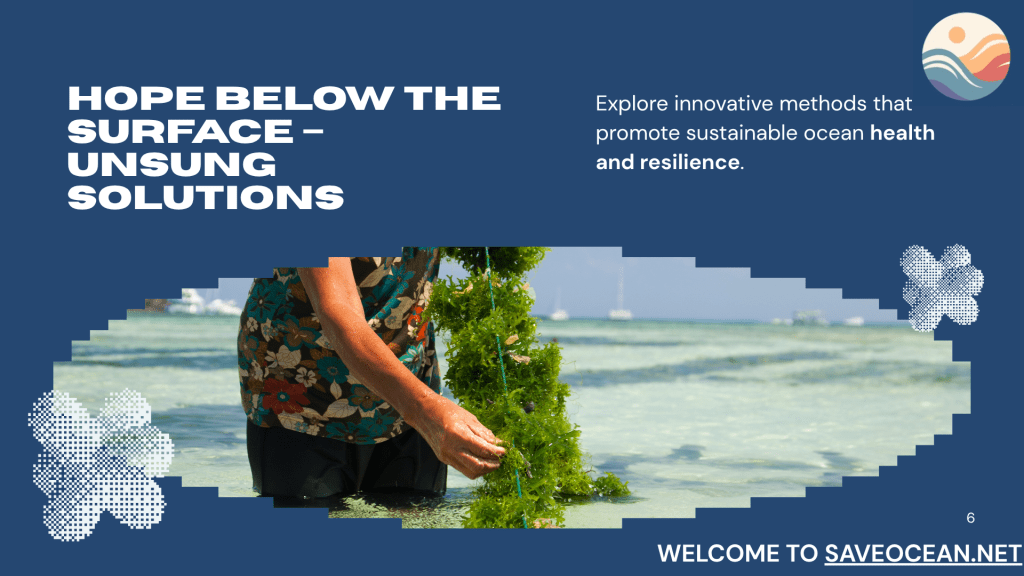
- Prioritize blue carbon ecosystems (mangroves, seagrasses, salt marshes) in both climate mitigation and adaptation plans.
- “The ocean must no longer be seen as a casualty of climate change, but as a crucial part of the cure.” — UNOC03 Panel, 2025
- Keep up the momentum to ban and reduce deep-sea mining until scientific evidence can ensure no net loss of marine biodiversity
- Ban bottom trawling and other destructive fishing practices
- Support Marine Protected Areas (MPAs) development and transition from “paper parks” to digitally monitored MPAs, integrating AI and real-time satellite tools.
- Legally protect at least 30% of ocean area by 2030—with Indigenous co-management, equitable access, and robust enforcement.
- Fully implement the Ballast Water Management Convention (D-2 standards) and require independent audits on compliance.
- Require wastewater treatment facilities to upgrade systems to remove active pharmaceutical ingredients (APIs).
- Make ocean data open-access, interoperable, and localized—especially for Small Island Developing States (SIDS) and Indigenous communities.
- “What we cannot measure, we cannot protect.” — UNESCO Ocean Decade Statement
- Support community-led ocean stewardship, especially among Indigenous peoples, small-scale fishers, and youth leaders.
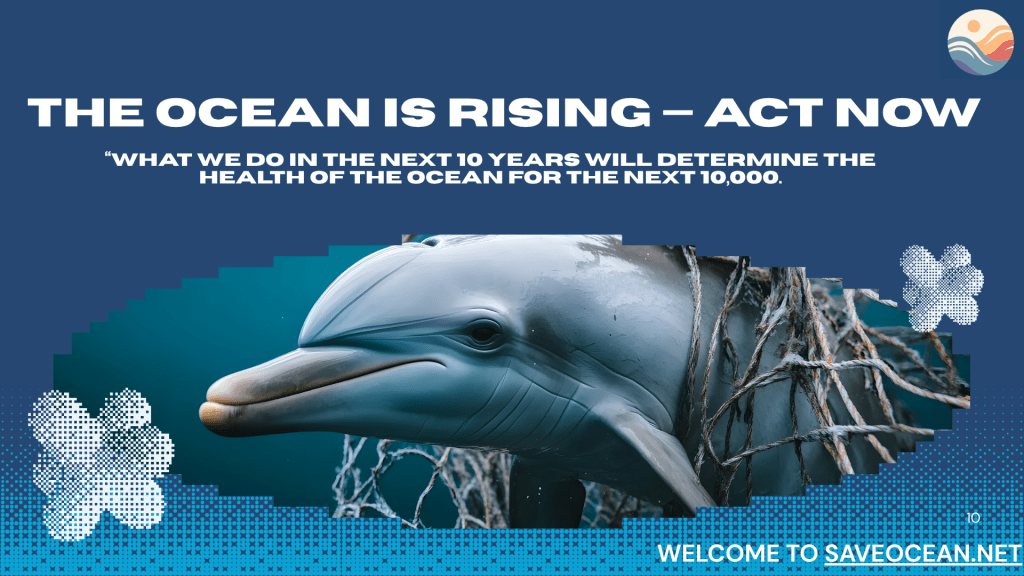
2025 is not just another year—it is the turning point generation’s moment. From invasive pathogens hitchhiking on ships to acidifying seas and disappearing coastal wetlands, the threats are real. But so are the tools, treaties, and voices ready to reverse course.
Let this be the decade of regeneration, not regret.
Let us act—not react—to secure the living blue foundation of our planet.
 SaveOCEAN
Leave a comment