
An evidence‑based overview of Italy’s most urgent climate & ocean challenges—and pathways forward.
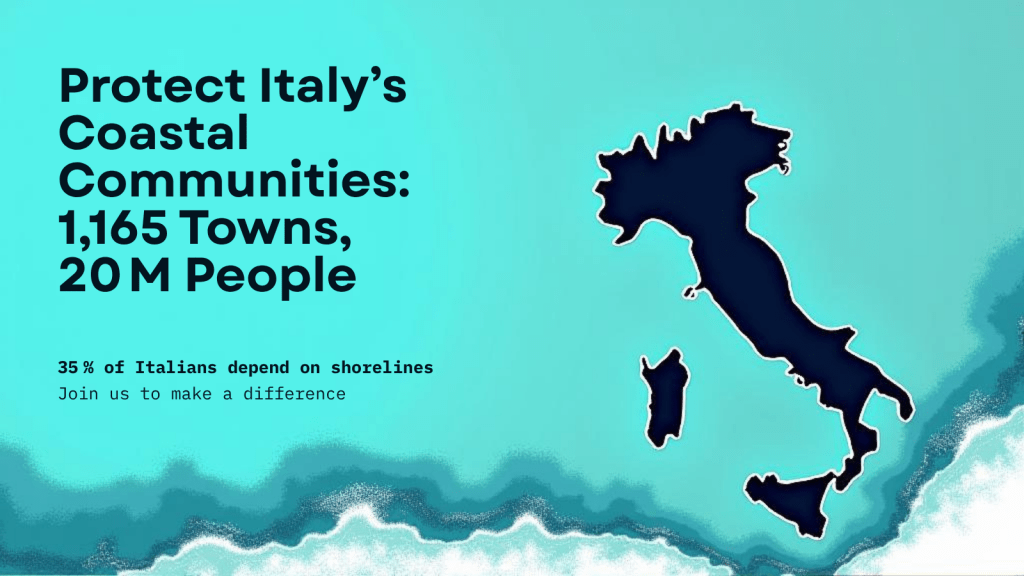
Italy’s “coastal communities” – defined as municipalities with marine frontage – number about 1,165 (≈15 % of Italy’s) and host 35 % of the national population which counts to roughly 20 million people.
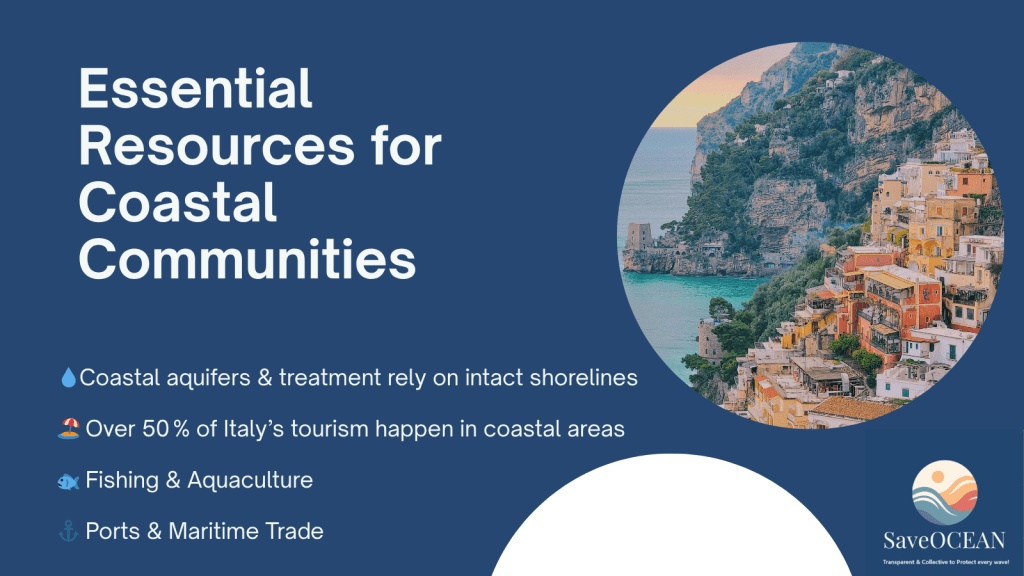
These towns and cities depend on healthy coastlines for:
- Drinking water & sewage services
- Tourism & hospitality
- > 50% of Italy tourism happen in coastal areas with 9.5 million cruise passengers visit ports in 2023.
- Fishing & aquaculture livelihoods
- Port operations & maritime trade
Climate and coastal area challenges:
Scorching Heat & Drought
- Heatwaves & Wildfires: Europe is warming twice as fast as the global average, fueling record fires in Mediterranean Italy. In 2025 alone over 227,000 ha have burned—more than double the 20‑year average for this season Reuters.
- Island Drought: Sicily and Sardinia’s “exceptional” drought conditions are now 50% more likely due to climate change—aggravating water scarcity, threatening agriculture, and stressing urban supply systems Earth.Org.
- Po Basin Emergency: In summer 2022, the Po River’s historic low flows led Italy to declare an official drought emergency, jeopardizing hydro‑electric power and freshwater for millions Wikipedia.
Floods, Storms & Coastal Erosion
- Sewage Overflows: Heavy rains in Rimini now trigger ~10 annual bathing‑water bans, as combined sewers can’t cope—contaminating beaches and marine life PreventionWeb.
- Violent Storms: Rising Mediterranean SSTs (warming at 0.4 °C/decade) have fueled sudden storms—like the July 2024 gale that sank a yacht off Sicily, a tragedy linked to fiercer weather patterns ReutersForesight.
- Eroding Shores: ISPRA identifies 54 of 644 coastal municipalities where over half the shoreline has retreated—risking homes, tourism economies and cultural heritage isprambiente.gov.it.
Warming Seas & Acidification
- Marine Heatwaves: In summer 2023, Mediterranean temperatures peaked +6 °C above normal, triggering catastrophic fish kills along Italy’s west coast—revealing a rapidly deteriorating marine climate Sea Shepherd Global.
- Overfishing & Biodiversity Loss: The Mediterranean is the world’s most overfished sea. Warming exacerbates stock collapse, undermining fisheries that sustain coastal communities.

Plastic & Chemical Pollution
- Trans‑Adriatic Threats: Italy’s Adriatic coast bears chronic nutrient and plastic loads. Under the EU’s PEPSEA project, Italian and Croatian scientists flag microplastics, untreated effluent and agricultural runoff as top stressors on fish and seagrass beds The Parliament Magazine.
- Microplastic Hotspots: Urban centers wash tens of tonnes of synthetic fibers into coastal waters each year, seeding the “plastisphere” that carries pathogens and additives into marine food webs.
Proven & Emerging Solutions
| Challenge | Current Response | Innovative Next Steps |
|---|---|---|
| Heat & Drought | – Expand renewables; phase out coal by 2025 – Upgrade reservoirs & reduce leaks | – AI‑driven irrigation scheduling – Desalinization acceleration. |
| Floods & Erosion | – Living shorelines with Posidonia meadows – Flood‑plain zoning & early warning systems | – Retractable breakwaters (biodegradable composites) – Community‑led “managed retreat” with eco‑tourism reinvestment |
| Marine Heat & Overfishing | – New Marine Protected Areas / FRAs – Seasonal no‑take zones | – Kelp farms to cool & oxygenate bays – Autonomous temperature sensors + predictive alerts for fishers |
| Pollution & Plastics | – Interreg PEPSEA cross‑border clean‑ups – EU single‑use plastic bans | – Algal bioreactor barriers at key river mouths |
A Call to Action
Advocate for coastal realignment policies.
Support green infrastructure—wetlands, permeable pavements & living dikes.
Adopt zero‑waste habits and choose durable, natural fabrics.
Amplify: share this summary and visit SaveOcean.net to join Italy’s coastal revival movement.
Learn more by joining SaveOcean.net
 SaveOCEAN
Leave a comment