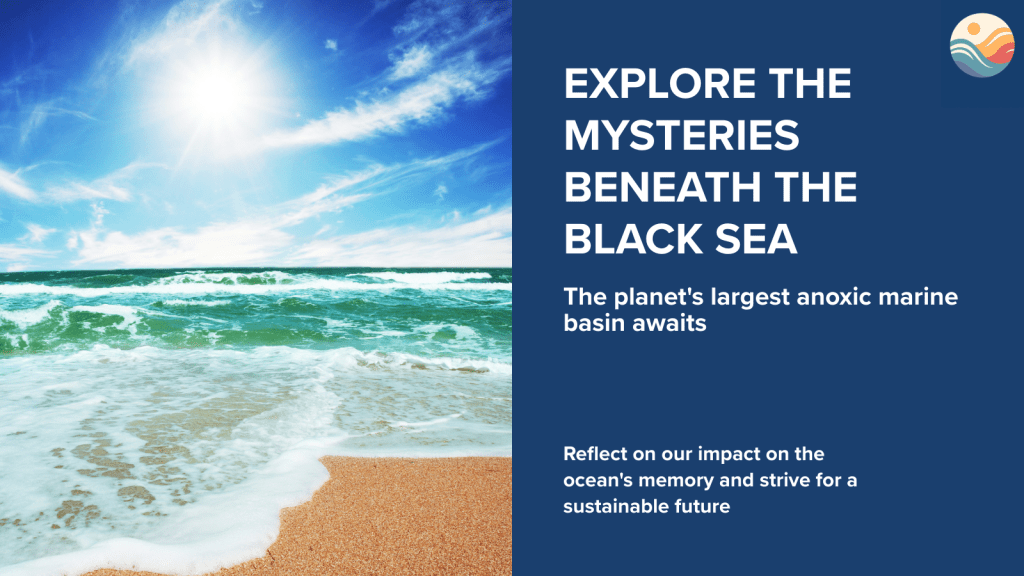
Looking from the Black Sea beach towards the water it looks simple and calming. Beneath, it is layered: a sunlit surface, a wafer-thin border where oxygen fades, and a deep realm run on sulfur. This is the planet’s largest anoxic marine basin in the modern ocean, a living reminder that seas keep long memories of what we pour into them, take from them, and ask them to endure.
Wow moment: Deep, oxygen-free water preserves history
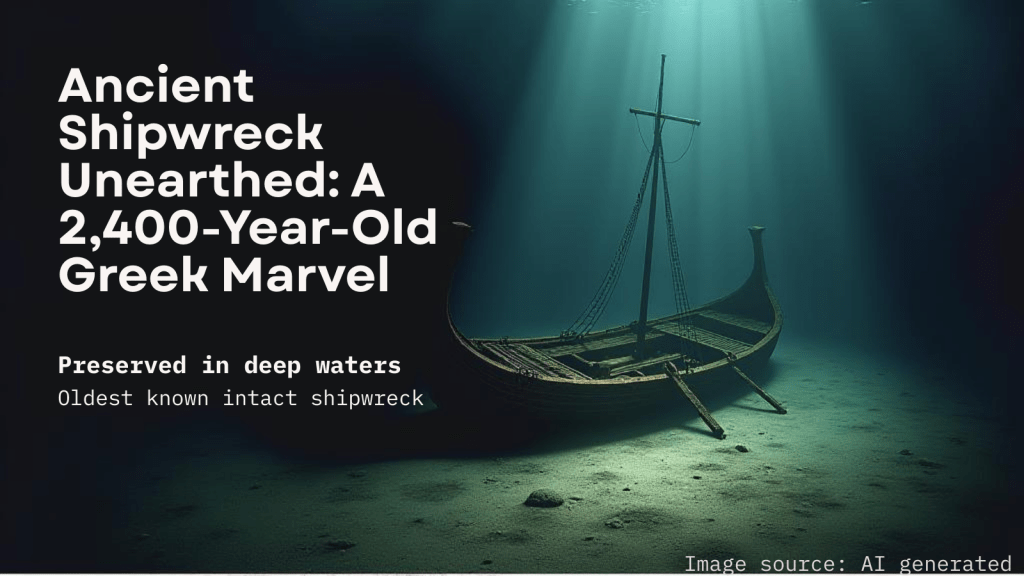
In 2018, scientists found a 2,400-year-old Greek ship—mast, rudder, benches intact—on the Black Sea floor.
It’s the oldest known intact shipwreck ever discovered.
Size & setting (the big picture)
- ~422,000 km² (about the size of California, USA)
- Max depth: ~2,210 m
- Drainage basin: ~2 million km², reaching far beyond the six coastal states.
- People: ~160 million live in the catchment.
Two rivers in one strait—every day
Did you know that two seas are trading water in opposite directions at the same place—every day?
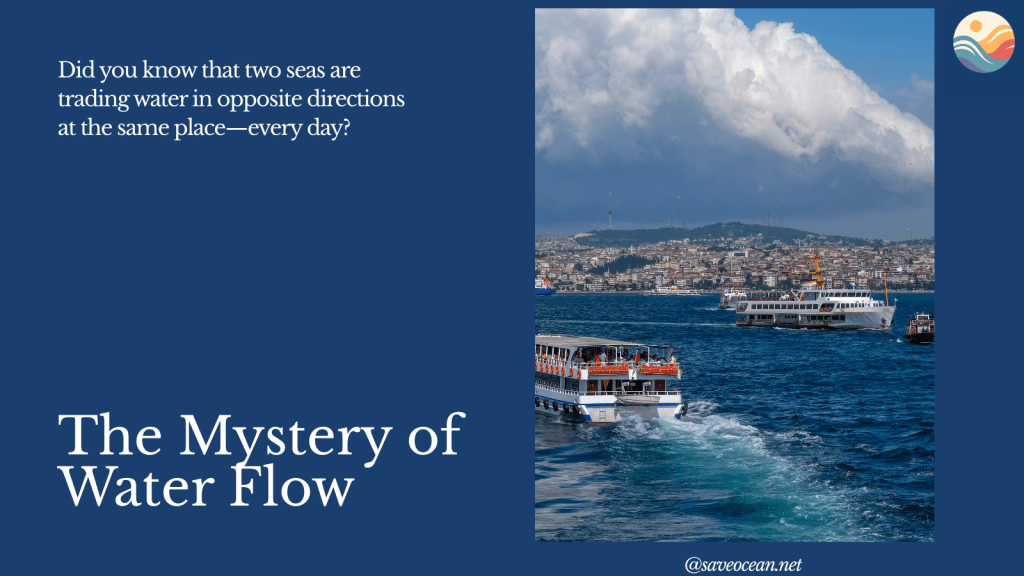
Stand on the Bosphorus in Istanbul and and watch two invisible rivers pass
- A surface current carries Black Sea water out to the Sea of Marmara.
- A denser, saltier undercurrent flows in beneath it.
A sea in layers (and why it matters)
- 87–90% of the Black Sea’s volume is anoxic (sulfidic).
- The oxygenated layer has thinned: the penetration depth shoaled from ~140 m (1955) to ~90 m (2015).
- Basin-wide, the oxygen inventory fell ~44% (1955–2015).
- That makes a thin “living lid” rests on a vast, chemistry-driven deep—a big deal for life at the boundary.
What Feeds the Sea
- Big rivers: Danube, Don, Dnieper—carry nutrients that can tip coastal waters toward algal blooms.
Fisheries at a glance
- Anchovy and other small pelagics dominate catches.
- Across the Mediterranean + Black Sea, the share of overfished stocks has fallen to <60%, yet fishing pressure is still too high in many cases.
- In the Black Sea, key species (e.g., turbot, anchovy, horse mackerel) are over-exploited or uncertain as found in recent (2025) EU briefings.
Ancient travelers, modern risks
- Sturgeons—long-lived “dinosaurs” of the water—still migrate between the Danube and the Black Sea, but are critically endangered.
- The Black Sea has its own dolphin subspecies. Bycatch occurs—and harbour porpoise bycatch is the critical, quantifiably unsustainable problem locally.
What is New
In July 2025, the European Commission’s Blue2 framework now provides a spatio‑temporal ecosystem model of the Black Sea (1995–2021).
- It links hydrology, biogeochemistry, food webs, and fleets—so policy can compare scenarios, not guess.
- It’s a baseline you can test policy against—fisheries, conservation, water quality—so decisions stop guessing and start measuring.
- It confirms what many along this coast already feel in their bones: biomass has declined across most functional groups; resilience has thinned.
What are the Problems

- A crowded stress map. Overfishing, pollution and nutrient loading, agricultural runoffs, pharmaceutical discharge, untreated wastewater, invasive species, shoreline erosion, and climate change act together; recent conflict has layered on chemical, noise, and habitat damage along parts of the coast.
- Food-web hinges. Gulls and cormorants, sprat, horse mackerel, and mullets emerge as structuring groups cannot be moved, if they move the whole web shifts.
- History matters. In the late 1980s a comb jelly, Mnemiopsis leidyi, arrived (from ballast water) and exploded in number, eating the same zooplankton and fish eggs that anchovies need. Anchovy catches crashed; the food web jolted. In the 1997 another jellyfish, Beroe ovata, showed up—a predator of Mnemiopsis—and helped bring numbers down.
Why this baseline matters
Policy-ready scaffolding. Blue2 is designed to support the Marine Strategy Framework Directive, Water Framework Directive, and Common Fisheries Policy—so scenarios can be compared across basins, not argued from scratch.
The temptation with a sea this complicated is to tell ourselves we need one more study before we start. The new ecosystem baseline flips that script: it gives policymakers, fishers, and civil society a shared map to argue with productively. It shows where the web is taut, where it’s frayed, and what happens when you pull one strand to save another. In other words, it lets the Black Sea speak in numbers and narrative at once.
The sea remembers. But memory isn’t destiny. If we align advice, incentives, and everyday choices with what the models and measurements already show, the Black Sea can write a different chapter—one where oxygen holds deeper, food webs grow sturdier, and coastal voices are heard not only in crisis, but in the quiet days when recovery becomes routine.
The sea that remembers
If you could trace one line through the water column here, it would be the oxic–anoxic boundary—that wafer-thin interface where oxygen fades and hydrogen sulfide begins. Its depth shifts with seasons and circulation, but the story holds: most of the basin’s volume is anoxic, and small changes up top ripple down into chemistry that takes decades to unwind.
That’s why simple surface numbers can mislead; context—salinity, temperature, flow, and history—turns data into meaning.
What recovery looks like
Recovery won’t be a single win; it will sound like many small agreements kept over time.
- Fish for tomorrow. Pair catch rules with real enforcement, protect nursery grounds, and reward selective gears. In a system already stretched, every avoided juvenile and every avoided bycatch is a deposit back into resilience.
- Cut nutrients at the source. Eutrophication and hypoxia are not abstract—they reorganize ecosystems and lower the ceiling for predators to return. Wastewater, agriculture, and urban runoff are levers we can pull in months, not decades.
- Mind the invaders. Mnemiopsis was a warning; shipping and warming seas keep the door open. Early detection and ballast-water diligence are cheaper than living with the aftermath.
- Model, then act. Use the Blue2 baseline to test trade-offs before they become regrets. If a measure helps in the model and is feasible on the water, the next step is piloting, not postponing.
In the Danube Delta—the Black Sea’s great river mouth—Dalmatian pelicans are making a comeback helped by nesting platforms and wetland restoration.
How communities fit in
Science is only as strong as the hands that carry it. Around the Black Sea, that means:
- Citizen measurements with context. When schools and clubs log pH and temperature (with salinity, when possible) against a local “expected” band, those dots tell a story that managers can actually use. Pair with open dashboards so data travels.
- Harbor hygiene. Approved car-wash sites, bilge-pad use, and reliable pump-outs keep oily films and metals out of estuaries where river and sea trade breaths.
- Seafood questions that move markets. Three quick ones at the counter—what species, where caught, how caught?—push demand toward practices the model says will recover stocks.
- Share the baseline: Encourage local media and councils to use the new ecosystem model when discussing measures.
SaveOCEAN note
This article is part of SaveOCEAN’s “Baselines for Better Choices” series—turning complex marine science into tools communities can use. Want a classroom mini‑module (30 minutes) with pH/temperature logging and a local digital map?
Email us at ceo@saveocean.net.
Data & resources
- EU DG Environment news (24 July 2025): “A new model of the Black Sea ecosystem provides a valuable baseline for policy and assessment.”
https://environment.ec.europa.eu/news/new-model-black-sea-ecosystem-provides-valuable-baseline-policy-and-assessment-2025-07-24_en - Technical paper (open access, 2025): Serpetti, N. et al. “State‑of‑the‑art modelling for the Black Sea ecosystem to support European policies” (Blue2 baseline, 1995–2021).
https://journals.plos.org/plosone/article?id=10.1371/journal.pone.0312170 - Oxygen trends (1955–2015): Capet, A. et al. 2016. “Decline of the Black Sea oxygen inventory.”
https://bg.copernicus.org/articles/13/1287/2016/bg-13-1287-2016.pdf - Extent of anoxia & depth: EEA (regional seas report).
https://www.eea.europa.eu/en/analysis/publications/report_2002_0524_154909/regional-seas-around-europe/BlackSea.pdf - Area, depth, general facts: Encyclopædia Britannica – Black Sea.
https://www.britannica.com/place/Black-Sea - Catchment overview: EEA SOER briefing (Black Sea region).
https://www.eea.europa.eu/soer/2015/countries/black-sea - Nutrient contributions: World Bank (2025) Blueing the Black Sea – riverine P load shares (Danube/Don/Dnieper).
https://documents1.worldbank.org/curated/en/099063025112017220/text/P173334-2b625382-ee10-4bb8-9966-fb68fb62dd06.txt - Fisheries status & trends: FAO GFCM State of Mediterranean and Black Sea Fisheries 2023 (SoMFi 2023).
https://www.fao.org/gfcm/publications/somfi/somfi2023/en/ - EU policy briefing (2025): European Parliament Research Service – “European marine fishing areas: The Black Sea.”
https://www.europarl.europa.eu/RegData/etudes/BRIE/2025/767238/EPRS_BRI%282025%29767238_EN.pdf
 SaveOCEAN
Leave a comment