
The alarm bells are no longer distant; they are ringing in the boardrooms of the world’s largest companies.
The World Economic Forum, in collaboration with Accenture, has released a sobering report, “Business on the Edge: Building Industry Resilience to Climate Hazards,” which shatters the illusion that the climate crisis is a future problem.
It is a present-day balance sheet reality, and its findings underscore our core mission at SaveOCEAN: the health of our planet, especially our oceans, is inextricably linked to the stability of our global economy and society.
This report is a recommended reading for anyone who believes in a sustainable future. It moves beyond abstract warnings to quantify the staggering financial costs of our deteriorating Earth systems.
What the report says
The Stark Financial Reality
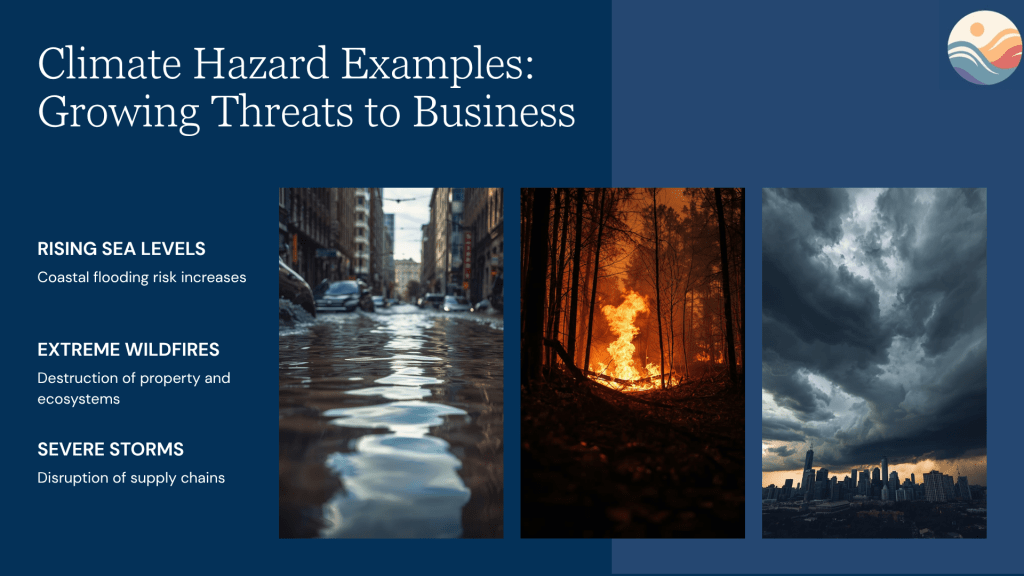
The report’s economic analysis reveals that “business as usual” is a direct path to financial crisis. Climate hazards are no longer isolated incidents but a relentless, growing threat to corporate profitability.
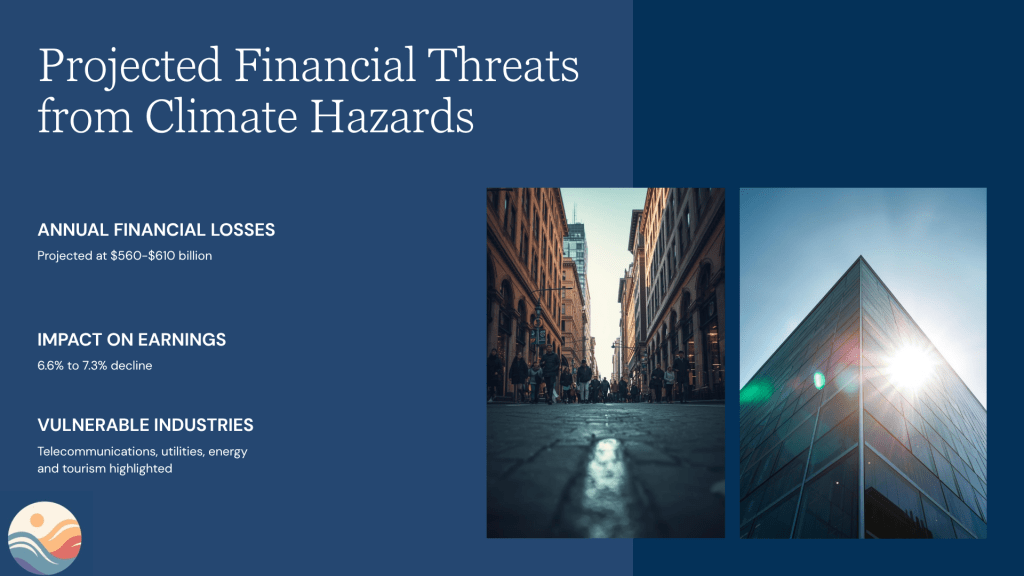
Massive Annual Losses: By 2035, climate hazards like extreme heat, flooding, and tropical cyclones are projected to cause $560-$610 billion in annual losses to the fixed assets (property, plants, equipment) of listed companies. This figure could climb to as high as $1.1 trillion by 2055.
A Direct Hit to Earnings: These losses translate into a devastating drop in average company earnings of 6.6% to 7.3% every single year by 2035. This is a recurring shock comparable to a global pandemic or financial crisis, but without the prospect of a quick recovery.
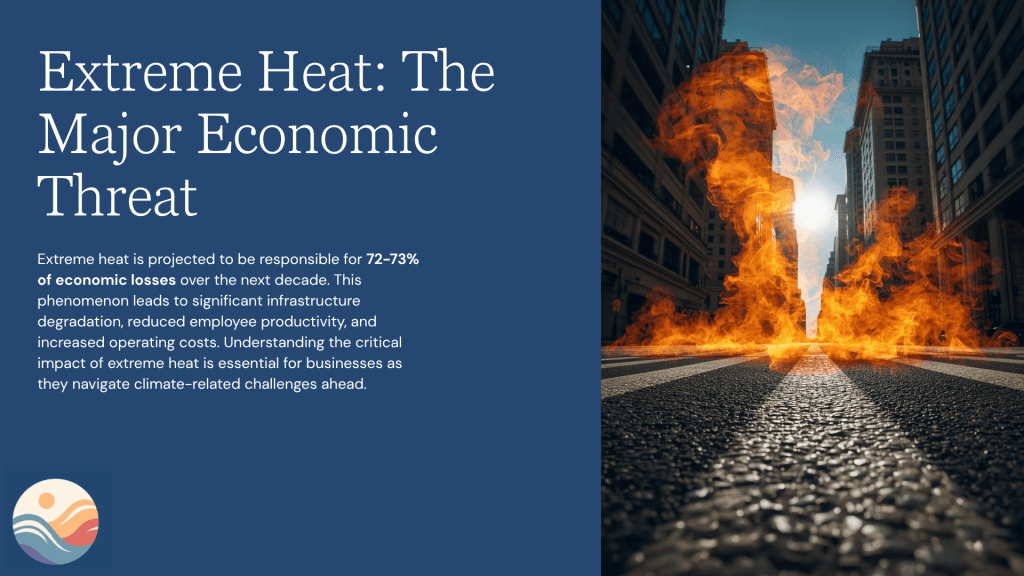
Extreme Heat is the Primary Driver: A staggering 72-73% of these projected losses over the next decade will be driven by extreme heat, which degrades infrastructure, reduces employee productivity, and increases operating costs.
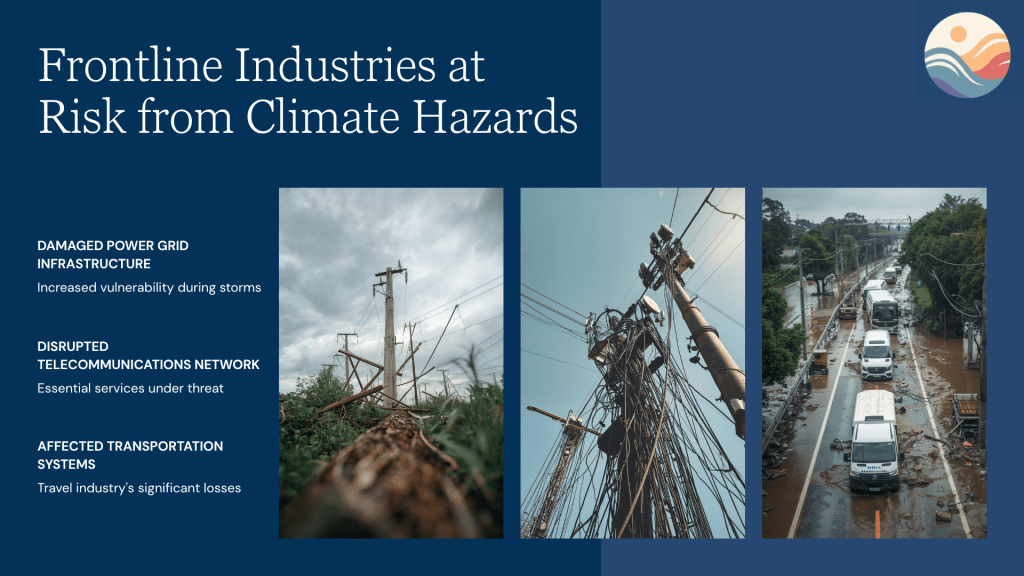
Frontline Industries: The sectors providing the essential “plumbing” of our economy are most exposed. Telecommunications and utilities (think: data centers, grids, pumps) then energy and travel companies face potential annual earnings shocks of over 20% by 2035.
Why this is a board-level ocean risk
The report bridges the gap between financial data and the underlying planetary science, confirming what we at SaveOCEAN have long advocated: we are pushing our planet’s life-support systems to the brink of irreversible collapse.
At our current level of global heating, five critical Earth systems are already at imminent risk of crossing a “tipping point,” a threshold beyond which change becomes self-perpetuating and irreversible.
Greenland and West Antarctic Ice Sheet Collapse: These melting giants are close to their tipping points and already represent a locked-in sea-level rise of 10 meters. This will directly impact the 630 million people living in coastal areas projected to be below annual flood levels.
Warm-Water Coral Reef Die-Off: At 1.5°C of warming, 99% of the world’s coral reefs—the nurseries for a quarter of all marine life—will face heatwaves too frequent for them to recover from and face near-total loss at 2°C. This threatens the food security and livelihoods of half a billion people.
Labrador & Irminger Seas Convection Collapse: This critical part of the Atlantic Ocean’s circulation (AMOC), which acts like a planetary air conditioning system, has slowed by 15% since 1950 and is in its weakest state in a millennium. Its collapse would catastrophically alter weather patterns, shifting rain belts and causing unprecedented droughts in regions like the Amazon.
Boreal Permafrost Abrupt Thaw: Considered a climate “wildcard,” the Arctic’s permafrost holds twice as much organic carbon as our entire atmosphere. As it thaws, it releases massive amounts of CO2 and methane, creating a dangerous feedback loop that accelerates global warming beyond human emissions alone.
The Path Forward: From Risk to Resilience
The report’s most crucial message is a call to action. Simply reducing emissions (mitigation), while essential, is no longer sufficient. We have entered an era where adaptation and resilience are not optional, but imperative for survival and prosperity.
Businesses must move beyond seeing climate as a peripheral issue and integrate it into the core of their strategy, operations, and capital investment decisions.
The report outlines a clear framework for action:
Enhance Resilience: Business leaders must conduct detailed audits of their operations and supply chains to map climate risks at the asset level. They must invest in climate-resilient infrastructure and develop contingency plans to maintain operations and protect their workforce during extreme weather events.
Capitalize on Opportunities: This crisis also presents an opportunity for innovation. The report highlights that for every $1 invested in adaptation, companies can see a return of $2 to $19. There is a growing market for climate-resilient products, services, and technologies—from heat-stable medicines to regenerative agriculture and circular business models.
Shape Collaborative Outcomes: No single company can solve this alone. The report calls for bold partnerships across value chains and with local communities, governments, and scientific experts. This includes investing in nature-based solutions, like restoring the mangroves and coral reefs that serve as natural coastal defenses, and co-developing solutions with the communities on the front lines.
The science is clear, and the economics are now undeniable. The choice is no longer between profit and the planet. True, lasting prosperity can only be built on a foundation of a healthy, resilient, and thriving global ecosystem. It’s time to act.
Action checklist
For ports & coastal utilities
- Treat coral/mangrove protection as infrastructure: reefs buffer waves; mangroves cut surge.
- Pre-plan cooling centers and blue-green corridors.
For tourism
- Diversify tourism products away from single-reef dependency; invest in reef-friendly moorings and shoreline nature-based solutions to maintain beaches and brand value.
For seafood & blue economy SMEs
- Harden cold chains against outages (thermal storage, solar + battery); shift to lower-heat, lower-water processing tech; insure for surge + downtime.
- Join early-warning networks for marine heatwaves; pre-plan harvest/relocation triggers and habitat refugia.
For tech & telecoms near coasts
- Plan new data facilities away from flood plains; design for wet-bulb heat limits; recycle water and add dry cooling options; model multi-day grid stress scenarios.
How we’ll help
- Translate science to action: We turn hazard maps into asset-by-asset checklists and pair them with reef/mangrove projects that measurably reduce risk.
- Proof, not promises: We’ll track and monitor in real-time so adaptation wins are visible to boards and communities.
- Coalitions over silos: We bring together ports, utilities, hotels, fishers, youth groups and scientists to co-fund nature + infrastructure bundles that pay back.
 SaveOCEAN
Leave a comment