
The race for critical minerals is real. So are the risks of treating the abyss as a shortcut. As governments debate whether—and how—to mine polymetallic nodules thousands of meters below the surface, one principle keeps surfacing: pause and prove safety first.
In 2025, the International Seabed Authority (ISA) again negotiated exploitation rules (“the Mining Code”) but did not finalize them—leaving no green light, and no final safeguards.
What’s actually on the table
Demand for nickel, cobalt, copper, and manganese for electrification has pushed industry toward the Clarion-Clipperton Zone and other areas beyond national jurisdiction. The ISA is still working through unresolved questions: environmental baselines, liability, benefit-sharing, and enforcement.
In practical terms : no commercial mining yet and no agreed standards to guarantee protection.
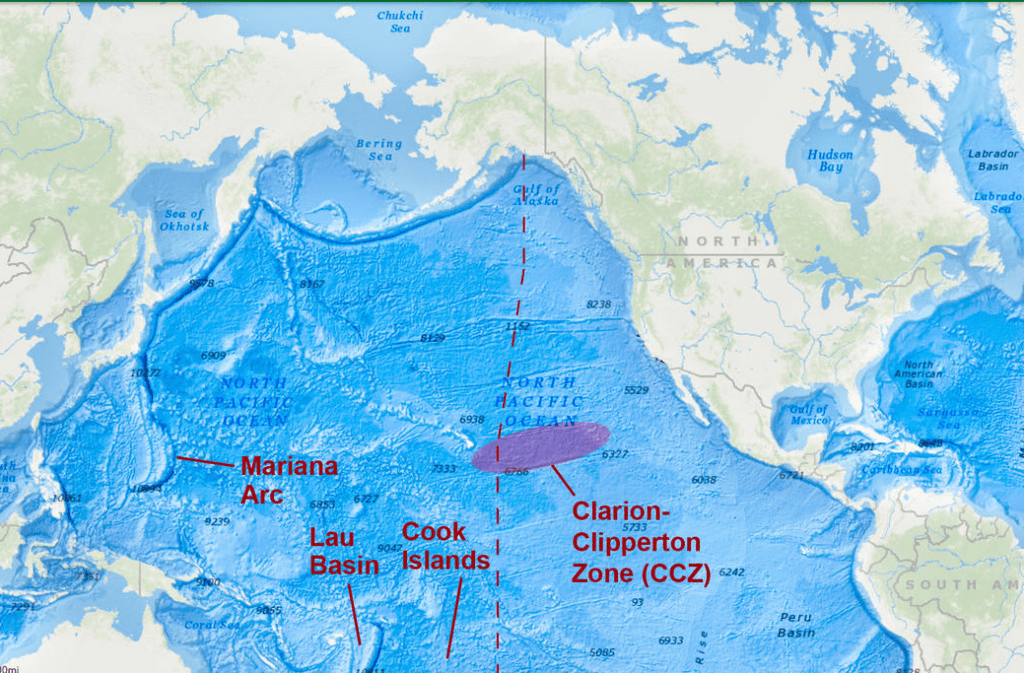
By USGS – https://www.usgs.gov/media/images/locations-clarion-clipperton-zone, Public Domain, https://commons.wikimedia.org/w/index.php?curid=84414340
The science isn’t neutral
New peer-reviewed studies keep tightening the caution lens. A 2025 Nature paper tracking a test-mined area finds impacts persist for decades and communities remain altered, even where some recolonization occurs.
Other research shows sediment plumes can travel kilometers beyond disturbance sites, smothering life and clouding fragile processes.
These aren’t hypotheticals; they’re mechanisms for long-lived change in the planet’s largest, least-understood biome.
The precautionary majority is growing
A rapidly expanding group of countries now backs a moratorium, precautionary pause, or ban while rules and science catch up—a coalition that spans small island states, major economies, and coastal nations. France supports a ban; Canada, New Zealand, the UK and others support a pause; dozens more signaled positions through 2025, including at the UN Ocean Conference in Nice.
The direction of travel is clear: don’t open a new extractive frontier without proof of safety and fairness.
Why “minerals for the transition” isn’t the whole story
The energy transition needs metals, but source choice is a policy decision, not a geological fate.
There are arguments both for and against deep-sea mining, and the “for” case hinges on assumed lower social and biodiversity costs than some land-based sources.
That comparison is not yet demonstrated for the abyss, where baselines are thin, life histories are slow, and recovery spans centuries. Meanwhile, recycling, redesign, circular supply chains, and demand-side innovation can compress the minerals gap—without opening a planetary blind spot.
Governance gaps we must close (before—not after—the fact)
- Baselines & thresholds: No global agreement on what constitutes “serious harm,” how to measure it, or how much cumulative impact is tolerable in an interconnected deep ocean.
- Monitoring & enforcement: Real-time plume tracking, noise footprints, and biodiversity sensors aren’t standardized, and liability for transboundary harm remains hazy.
- Equity & benefit-sharing: The seabed is the “common heritage of mankind.” Turning that into transparent revenue and technology-sharing is unfinished work in the evolving Mining Code.
SaveOcean’s position
Pause now. Plan better. The burden of proof sits with those proposing irreversible change in a system that moderates climate, stores carbon, and harbors slow-growing, poorly known life.
Leading science and conservation bodies echo this stance; even after intense 2025 talks, the ISA did not finalize exploitation rules underlining the need for restraint.
A constructive path forward (2025–2030)
Supercharge circularity: scale battery reuse, high-yield recycling, and material substitution to cut virgin demand curves this decade.
Fund an open science program across key provinces: long-term observatories, plume dispersion trials, genomic baselines, and transparent data commons.
Protect conflicts with other ocean users—fisheries, conservation, cultural areas—through marine spatial planning before licensing any operations.
Align with broader ocean treaties (BBNJ/High Seas) to ensure protected areas and access/benefit-sharing aren’t undermined by mining corridors.
What can you do?
Back circular demand: Choose devices from companies with published recycled-content targets and end-of-life take-back programs.
Share the signal: The deep sea isn’t a dumpster; it’s life support. Share the evidence and help normalize “Plan A: Protect the Deep.”
Bottom line
We don’t have two oceans—one to experiment with and one to keep. The deep sea is not a “Plan B” for the energy transition; it’s a planetary life-support system.
Until we can prove that mining it will not cause lasting harm—and that benefits will be shared justly—the only responsible course is a global pause backed by investment in circular supply and open science.
 SaveOCEAN
Leave a comment