

Ocean Acidification (OA) presents a clear and present danger to marine calcifies, especially the globally vital shellfish aquaculture industry.
A recent study documenting the perceptions and adaptive strategies of Japanese commercial oyster farmers—a key component of global seafood production—offers critical insights, particularly when compared to the post-crisis experience of U.S. West Coast farmers. The findings underscore a global need for clearer awareness, localized knowledge systems, and targeted policy support to build true ecological resilience.
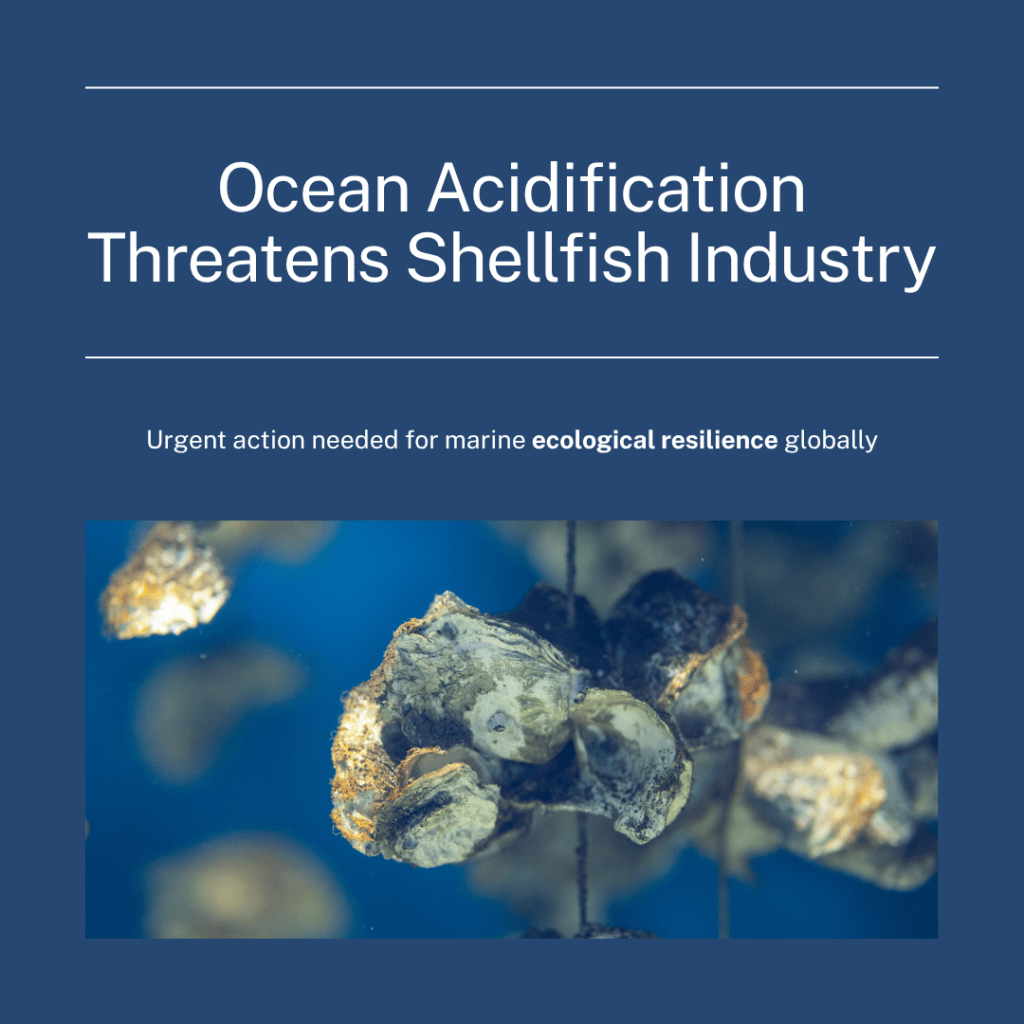
Japan’s oyster farmers: clear concern, complex signals
A new peer-reviewed study reports how Japanese commercial oyster farmers perceive Ocean Acidification and which strategies they consider viable. Two headline insights stand out:
Ocean Acidification is on the radar, but often masked by “noise.” A consistent challenge found across global shellfish farming communities is the difficulty in isolating the impacts of Ocean Acidification from other concurrent environmental stressors. Farmers frequently deal with temperature fluctuations, disease outbreaks, and nutrient runoff, making it nearly impossible to attribute phenomena like reduced shell growth or mass mortality solely to declining pH levels. This ambiguity highlights a crucial barrier to pre-emptive action and underscores the need for localized, accessible monitoring and diagnostic tools. Without clear attribution, securing farmer buy-in for OA-specific mitigation and adaptation strategies remains a diplomatic and scientific hurdle.
Adaptation knowledge is uneven. Compared with U.S. growers, there are fewer documented, industry-wide OA adaptations in Japan. When corrosive waters hit Pacific Northwest hatcheries over a decade ago, oyster larvae died by the billions—an unmistakable OA “signal.” That shock catalyzed a now-classic adaptation toolkit: continuous pH/CO₂ monitoring at water intakes, real-time alerts to avoid the most corrosive upwelling pulses, and buffering (adding carbonate alkalinity) in hatchery tanks. These steps helped save an industry and seeded broader coastal monitoring networks.
Recent reporting and syntheses show growers continuing to diversify responses—eelgrass plantings near farms to locally draw down CO₂, selective breeding/parental conditioning research, and coordinated policy support—while emphasizing that these fixes are partial and must be paired with emissions cuts.
Two Models of Adaptation: Post-Event vs. Pre-Event
The study provides a compelling comparison between two major aquaculture regions: the United States (U.S.), representing a “post-event” case following documented OA-related shellfish mortality, and Japan, which is analyzed as a “pre-event” case.
In both regions, common adaptive strategies center on increased flexibility in farm management—such as shifting planting and harvesting times—and a strong reliance on hands-on, practical learning. Farmers inherently use their accumulated experience to manage risk.
However, a fundamental difference lies in their approach to knowledge sharing and stakeholder engagement:
U.S. Model: Following devastating die-offs, U.S. farmers developed robust networks, actively collaborating with scientists, state agencies, and policymakers. This collaborative structure was essential for translating scientific data into actionable solutions, like early warning systems and hatchery water chemistry management.
Japanese Model: Japanese farmers, operating largely in a pre-event context, demonstrate similar farm-level flexibility but lack the reliance on networking with external stakeholders for OA knowledge and solutions. This siloed approach presents a significant vulnerability if a severe acidification event were to occur.
A Blue Policy Pathway for Resilience
The contrast between the two models reveals clear policy pathways for empowering farming communities worldwide, aligning perfectly with the spirit of the Sustainable Development Goals (SDG 17: Partnerships for the Goals).
Learning from the U.S. response, the study identifies several areas where policy and action can proactively support Japanese and other pre-event farming communities:
Enhanced OA Awareness and Education: Clear, localized communication about the specific threats of OA is essential to help farmers distinguish it from general stressors and prepare for future events.
Financial Support Mechanisms: Targeted financial aid and insurance programs are necessary to buffer against the economic shock of potential OA-induced mortalities, ensuring continuity of livelihoods (SDG 1).
Scientist-Farmer Collaboration: Establishing formal, trusted channels for collaboration between marine scientists and commercial farmers allows for the co-creation of knowledge, leading to more practical and effective monitoring and adaptive strategies.
The journey toward restoring our oceans demands that we look beyond national boundaries and learn from shared experiences. By leveraging targeted policy interventions and promoting robust global partnerships, we can transform vulnerable communities into true Blue Ocean Guardians, ensuring food security and a resilient blue future for all.
What growers say they need (across regions)
Surveys and interviews in California, British Columbia, and multi-region reviews converge on several asks:
Clarity in the “signal”: low-cost sensors and decision dashboards that translate chemistry into farm actions (e.g., when to intake water, set seed, or move gear).
Practical trials, not just papers: side-by-side demonstrations of buffering, selective breeding, and husbandry changes, co-run by farmers and scientists.
Risk-sharing finance: insurance pilots and credit lines to absorb shocks and invest in monitoring/retrofits.
Peer networks: farmer-to-farmer exchanges that spread what works fast.
A short list of field-tested adaptations
Hatchery buffering & timing: dosing with sodium carbonate/bicarbonate and scheduling intakes to avoid corrosive upwelling events. toolkit.climate.gov
Local nature-based draws: eelgrass meadows that can modestly dampen CO₂ and improve carbonate chemistry in farming areas. Axios
Sensing & early-warning: continuous pH/pCO₂ sensors at intakes, integrated with weather/upwelling forecasts. toolkit.climate.gov
Portfolio strategies: diversifying species and strains; exploring parental priming to boost larval robustness. fish.uw.edu
Policy implications
SDG 14 (Life Below Water): fund coastal OA observing where farms operate; incorporate farmer data into regional management to protect nursery habitats and water quality.
SDG 13 (Climate Action): pair local adaptation with national CO₂ cuts; include blue carbon habitats (e.g., eelgrass) in sub-national climate plans where science supports it.
SDG 12 (Responsible Production): mainstream OA-smart aquaculture standards (monitoring, buffering protocols, effluent controls) into certification and procurement.
Equity cross-walk (SDGs 1, 2, 5, 8, 10): coastal jobs, food security, and women- and Indigenous-led enterprises are directly exposed to chemistry shocks; tailor finance and training so smaller operators can adopt monitoring and upgrades first—not last.
Bottom line
The new Japan study underscores a global truth: farmers are already navigating a multi-stress ocean, and OA is both real and hard to isolate without tools.
Where those tools exist—and trust is built—adaptation moves from theory to daily practice. The opportunity now is use technology to make the solutions universal, affordable, and owned by farmers themselves.
Key sources
- Pang et al., Frontiers in Marine Science (2025): Japanese shellfish farmer perceptions of OA Frontiers
- NOAA/OA case materials & toolkits toolkit.climate.gov
- Ward et al. (2022) and subsequent syntheses (2025): West Coast farmer perceptions and adaptation priorities. ScienceDirect
- Changing waters, changing views: Stakeholder perspectives on ocean acidification and adaptations in shellfish aquaculture fish.uw.edu
 SaveOCEAN
Leave a comment