The Global Ocean Observing System (GOOS) 2025 Status Report confirms that the foundational infrastructure for understanding the ocean is both vital and critically vulnerable.
- Vital and Indispensable for climate projections, early warnings, biodiversity, blue economy decisions, etc.,
- but
- Critically vulnerable and fragile – uneven coverage, declining drifting buoys & ship-based observations, and over-reliance on a few contributors.
GOOS is calling for a new economic mindset: treat ocean observing as shared global critical infrastructure needing long-term, coordinated, multi-actor investment (governments + private sector).
There is a globally acknowledged, quantified infrastructure gap in ocean observing – and GOOS is openly asking for new partners and models. That is exactly the space SaveOCEAN can step into.
Key summary
Observations are the backbone of everything we care about
- Climate resilience, early warning, blue economy, and ocean health all explicitly depend on sustained observations.
- Report highlights concrete use cases (AMOC, El Niño, Southern Ocean via elephant seals, capacity building in South Africa) to show that data → decisions → outcomes is real, not theoretical.
System fragility is now recognized publicly
- The global observing system is subcritical and faces declining drifting buoy and ship-based observations. The current system is brittle and cannot sustain the data demands of the growing Blue Economy or the climate crisis.
- Uneven coverage, declining platforms, and dependence on a small club of funders are named as risks.
- This is an invitation for new actors, because the incumbents are signaling: “We can’t sustain this alone.”
Funding & Equity
There is uneven coverage and heavy reliance on a small number of contributors (i.e., wealthy nations/institutions).
- The data gap is also a sovereignty and equity gap. GOOS efforts are concentrated where wealth is.
Private sector & diversified partnerships are no longer optional
- The report explicitly calls for stronger private-sector engagement and new economic approaches.
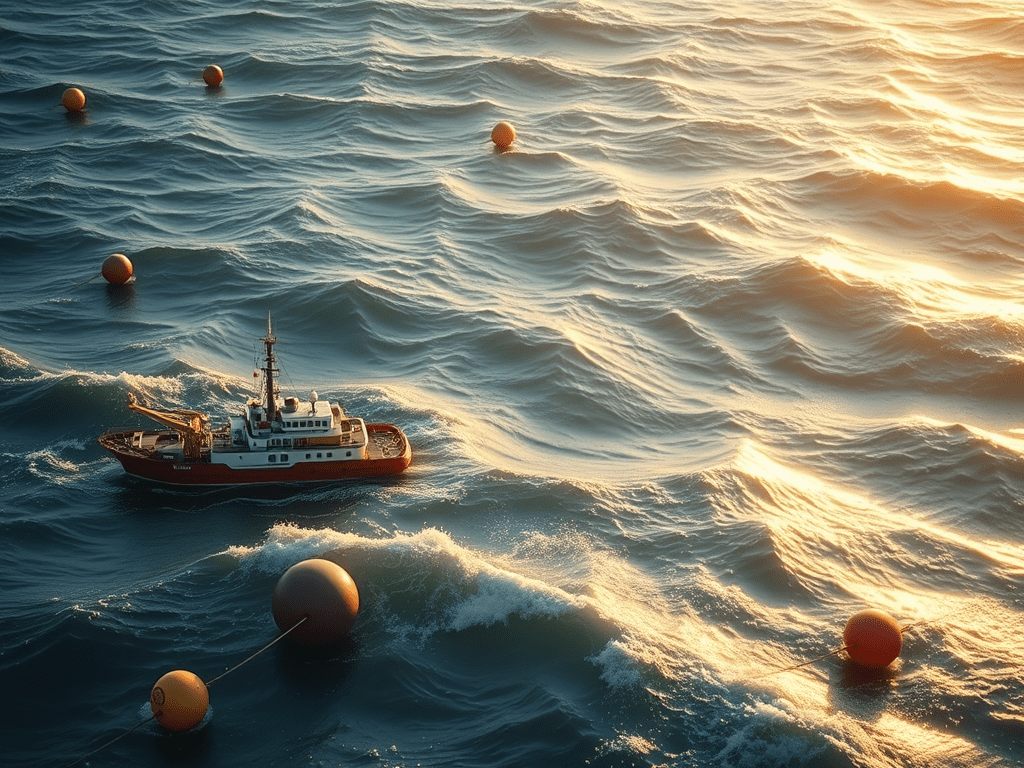
- A new initiative aims to transform 10,000 commercial vessels into real-time observatories.
- The private sector is the only viable scalability engine for observations.
Deep ocean & under-observed regions are high-impact gaps
- Companion GOOS material stresses that the deep ocean is critically under-observed, limiting climate services, resource management, and adaptation strategies.
- No single country can observe the ocean effectively on its own – which structurally justifies global, multi-actor platforms are required.
Accessibility & storytelling are being upgraded
- The report is in an interactive, more public-/decision-maker-friendly format – not just a technical PDF.
- GOOS is trying to move observing from “specialist concern” to “policy agenda item” – a door we can push open further.
High-Impact Projects
Progress is shown in forecasting the Atlantic Meridional Overturning Circulation (AMOC) and utilizing animal-borne sensors (elephant seals) for Southern Ocean data. These examples prove that non-traditional and co-designed data sources work.
Where SaveOCEAN can add value)
The report focuses on platforms and coverage, not on the last mile: translating observations into tools for coastal communities, investors, insurers, and city planners.
There’s no systematic framework for coastal community participation, indigenous knowledge integration, or benefit-sharing from observing investments.
We can explicitly build equity, co-design, and local value creation into every SaveOcean observing initiative.
Missing: low-cost sensors, citizen science, local fleets, and mobile apps that can complement formal networks. SaveOcean can lead on hybrid systems: combining official GOOS elements with community and private-sector contributions.
Role:
- Broker between GOOS, governments, communities, and private capital.
- Product builder for data-to-decision tools.
- Storyteller making the fragility of ocean observing legible to non-experts.
Takeaway note:
The GOOS 2025 Status Report quietly admits that the world’s “eyes on the ocean” are not yet good enough – technically, financially, or equitably.
SaveOcean’s strategic play is to help fix that: not by building another observing system, but by connecting this fragile backbone to money, markets, communities, and stories that can make it robust.
 SaveOCEAN
Leave a comment