
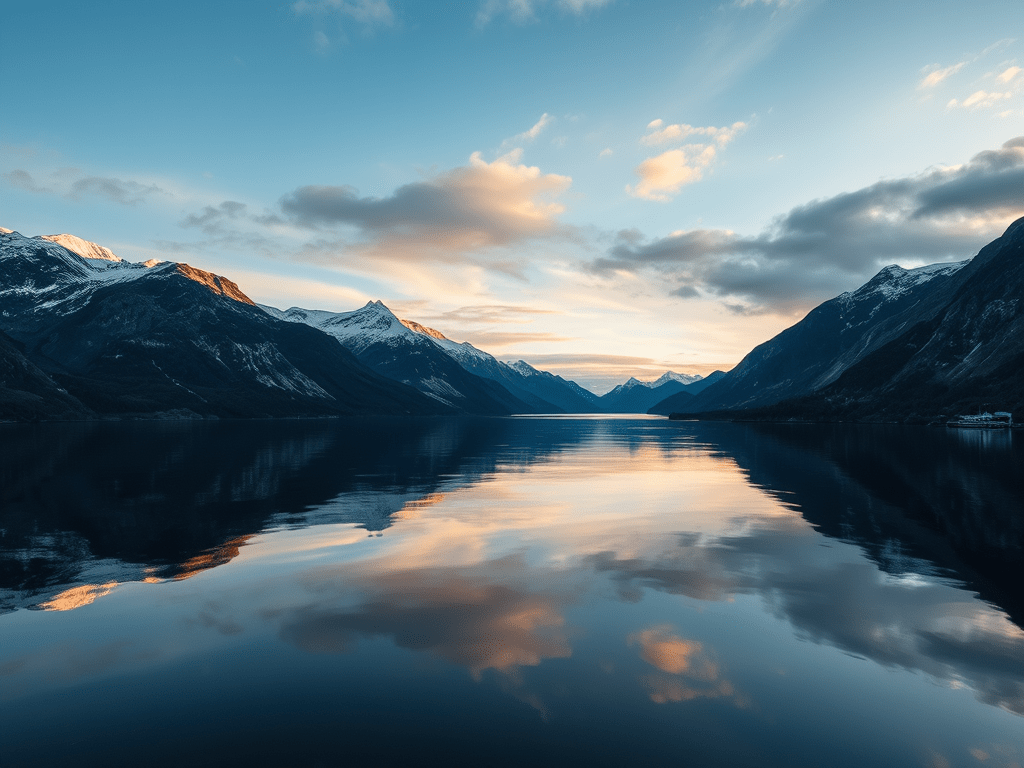
There is a specific kind of silence you find in the North. Standing on the edge of a Norwegian fjord, the water looks like black glass—ancient, impenetrable, and indifferent to us.
But if you look closer, the silence is a trick. Below the surface and just over the horizon, that water is working harder than perhaps anywhere else on Earth.
For decades, the environmental movement has told us a very specific story: To save the wild, we must retreat. We are told that “Nature” and “Economy” are two wolves fighting in a cage, and one must eventually eat the other.
But recently, I dove into a conversation coming out of Norway—specifically an interview via the Back to Blue Initiative regarding Norway’s ocean policy perspective and it suggests that this story isn’t just depressing. It’s wrong. Norway is effectively rebranding ocean conservation from a “preservationist” stance to a “productionist” stance. Their core argument is that long-term value creation depends entirely on ecosystem integrity.
Key Ideas
The Dinner Table Defense
The modern world is built on silos. The energy guys have their conferences; the fishermen have their union halls; the conservationists have their protests. They rarely meet, and when they do, it’s usually in court.
The central thesis is that you do not choose between industrial activity and nature. Norway argues that a sustainable ocean economy is the only ocean economy. They are positioning environmental standards as a competitive advantage (e.g., green shipping), rather than a regulatory burden.
Integrated Management Plans (The Secret Sauce)
Norway does not manage sectors in silos (fisheries vs. oil vs. wind). They use Integrated Management Plans where all sectors sit at the same table to divide the ocean space based on scientific data. This reduces conflict and provides predictability for investors.
Instead of fighting for scraps of the map, Norway forces every sector to sit at the same table. The oil executive sits next to the marine biologist. The wind developer sits next to the trawler captain. They look at the same data. They look at the same map. And they agree on how to share the house.
It transforms the ocean from a battlefield into a neighborhood.
The insight here is profound: Conflict creates waste. It wastes money, it wastes time, and ironically, it wastes nature. By removing the conflict through what they call “coexistence,” Norway isn’t just being nice; they are de-risking their entire economy. They are proving that protection is a prerequisite for production.
The 30% Trap
We love simple slogans. “30×30″—protecting 30% of the ocean by 2030—is catchy. It fits on a bumper sticker. It feels like a win.
But reading through Norway’s perspective, you realize that 30% is a trap. It implies that if we fence off a garden, we are free to burn down the rest of the house.
Norway is pushing a harder, more mature goal: 100% Sustainable Management.
They are arguing that we are responsible for the whole map. The 70% of the ocean that isn’t a marine park shouldn’t be a free-for-all; it should be a well-managed engine. This shifts our identity from “guardians of a museum” to “stewards of a living system.”
It’s a terrifying level of responsibility. It means we can’t just say “no” to everything. We have to learn how to say “yes” to the right things, in the right places, in the right way.
Data as Infrastructure:
The policy treats ocean data (mapping, biodiversity monitoring) as public infrastructure, similar to roads or power lines. The state provides the data baseline so private industry.
The Luxury of Order
The Norwegian model is a triumph of human cooperation. But it is also a triumph of privilege.
This system works because Norway has three things that are incredibly rare: deep pockets, high social trust, and a government that can actually enforce the rules. When they draw a line on a map, people respect it. When they demand data, companies provide it.
But how does this map overlap with the messy, chaotic reality of the rest of the world?
This is the Gap of Governance. It is easy to be a steward when you are not fighting for survival. But try exporting this model to the Global South, to coastlines where “enforcement” is a rumor and data is nonexistent. In regions where the choice isn’t between “wind or oil,” but between “eating today or starving tomorrow,” the polite table manners of the Norwegian boardroom feel like a fantasy.
The Polite Silence on “Coexistence”
The other shadow is the word “Synergy.” It’s a comforting corporate word. It suggests that if we just plan smart enough, everyone wins.
But the ocean is finite. And sometimes, two things simply cannot occupy the same space.
The interview glides over the bruises. It speaks of harmony, but it misses the chance to be honest about the hard trade-offs. We are heading toward a world of friction. You cannot have a pristine seabed and Deep Sea Mining. You cannot have endless offshore wind farms and unchanged traditional fisheries.
By avoiding these topics we make the future seem easier than it is.
“Coexistence” is a nice goal, but it often masks the reality of sacrifice. Someone is going to lose. Something is going to be displaced. And true leadership isn’t about pretending the conflict doesn’t exist; it’s about having the courage to make the hard choice when the synergy fails.
Why does it matter to us at SaveOCEAN?
Because for too long, we have operated on fear. Fear of collapse. Fear of industry. Fear of the future. We do need the Norwegian hope, but we also need the global reality.
The Norwegian perspective offers a glimpse of a different future one where we stop treating the ocean like a fragile victim and start respecting it as a powerful partner.
We need to build the off-road vehicle version. One that works where governance is weak. One that survives where trust is low.
It requires a high level of trust—something that is scarce these days. It requires data to be shared like public infrastructure, not hoarded like gold. It requires us to accept that humans belong in the picture, not just as destroyers, but as cultivators.
And we need to stop waiting for a world where nature and industry hold hands and sing. That world isn’t coming. The future is going to be a negotiation—sometimes a loud, angry one.
The map of the future isn’t empty blue water. It is a complex, busy grid. It’s messy. It’s difficult. But it’s the only ocean we have left.
It’s messy. It’s difficult. But it looks a lot like hope can build upon it.
Takeaway:
We need to stop waiting for a pristine past that is never coming back, and start designing the integrated future we actually need.
 SaveOCEAN
Leave a comment