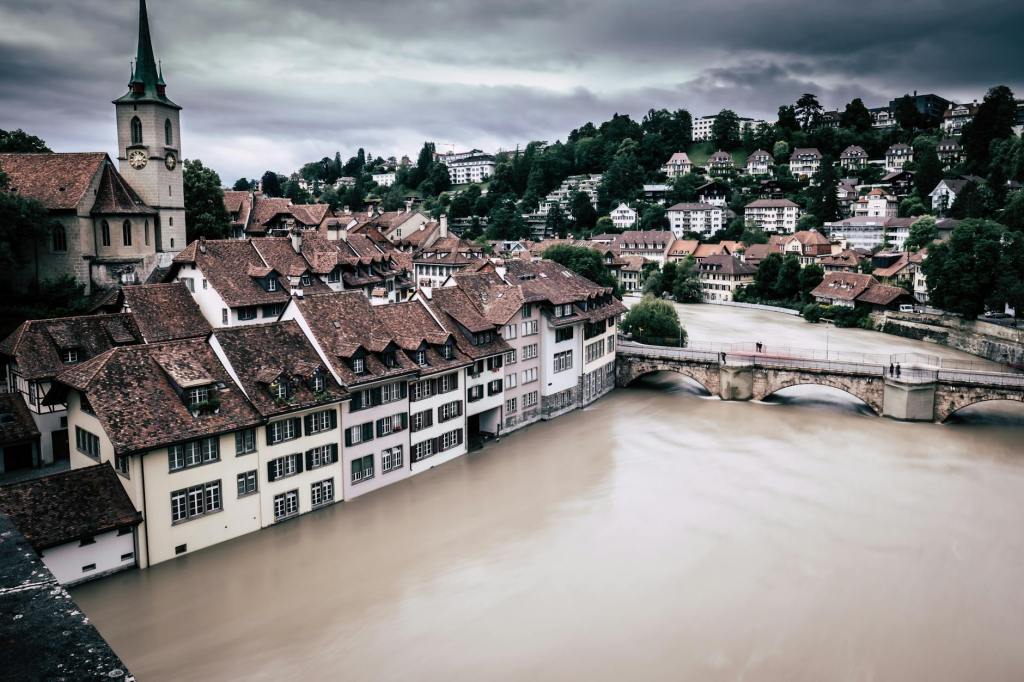
We treat the ocean mainly as a source of hazards to be dodged, not as a living system that can either buffer us or break us.
SaveOCEAN exists to challenge that.
Protecting and monitoring the ocean is not a nice-to-have add-on to early warning. It is early warning.
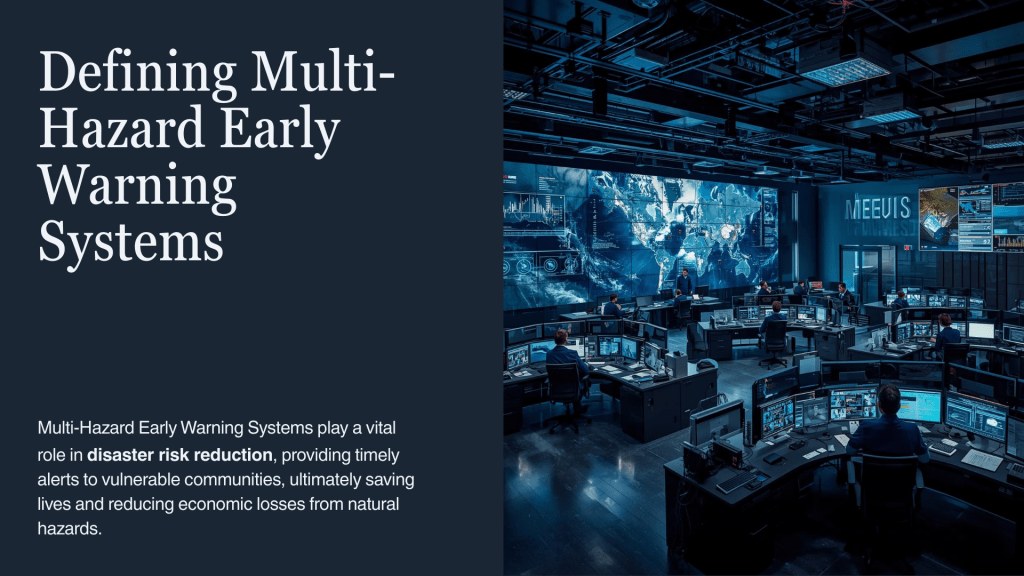
The new UNDRR report on the Global Status of Multi-Hazard Early Warning Systems 2025 is full of hard proof that early warning works.
Here are some takeaways:
- Countries with strong, multi-hazard systems have six times lower disaster mortality than those without.
- From 2015 to 2023, there were 2.7 billion pre-emptive evacuations. That’s 2.7 billion times someone got to leave before the worst hit.
What that means?
- Early warnings are literally buying people time.
At the same time, something quieter is happening:
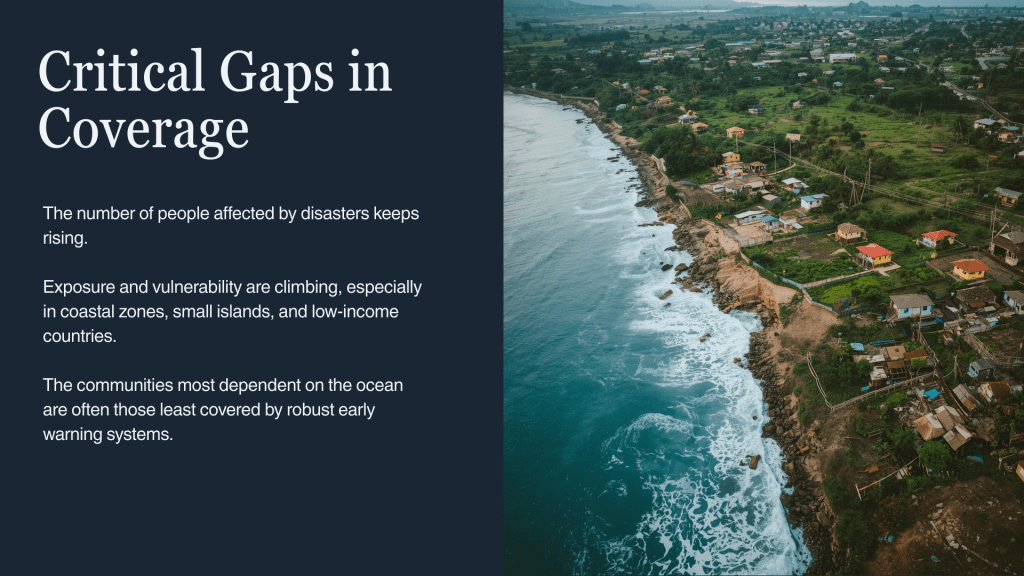
- The number of people affected by disasters keeps rising.
- Exposure and vulnerability are climbing, especially in coastal zones, small islands, and low-income countries.
- The communities most dependent on the ocean are often those least covered by robust early warning systems.
We are getting better at seeing the wave.
We are not getting better, fast enough, at seeing the reef that used to blunt it – or the mangrove that used to break it, or the seagrass meadow that used to keep the shoreline in place.
Our risk models track wind speed and wave height.
They rarely track reef die-off, mangrove loss, or collapsing fisheries as risk indicators.
That’s the gap SaveOCEAN is here to name, again and again:
You can’t build truly effective early warning systems while the ocean’s natural defense systems are being quietly dismantled.



The four pillars – and the missing fifth
The UN’s Early Warnings for All initiative is built on four pillars:
- Risk knowledge
- Detection, observation, monitoring & forecasting
- Warning dissemination & communication
- Preparedness & response
Plus cross-cutting enablers: governance, finance, technology.
All of that is essential. The report shows progress on every pillar:
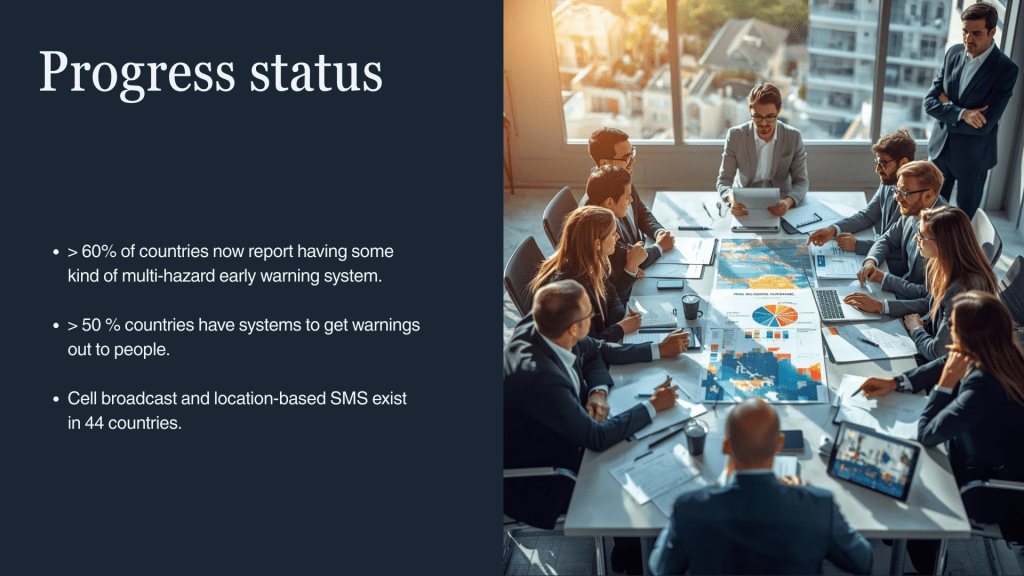
- Over 60% of countries now report having some kind of multi-hazard early warning system.
- “Comprehensiveness scores” are up 45% across regions.
- More than half of countries have systems to get warnings out to people.
- Cell broadcast and location-based SMS exist in 44 countries, and mobile alerts are increasingly used in disasters.
But the same report quietly admits something important:
Risk knowledge is still the weakest pillar.
Only about a third of countries say they have solid capabilities here.
Risk knowledge isn’t just: What is the wind speed?
It’s: Who lives where the water will go? Who doesn’t have a car? Who is undocumented and afraid to seek help? Which reef is already dead, so the storm surge will travel farther inland this year than last?
And this is where the “hidden fifth pillar” comes in — one that the report barely names:
5. Ocean health & coastal ecosystems
Because if your early warning system tells you “Storm surge will flood 500 homes” but doesn’t know that:
- Last year’s bleaching killed half the offshore reef,
- The mangroves were cut for a “view of the sea”, and
- The fishers now live in makeshift housing even closer to the water…
…then your math is wrong before the alert is even written.
The ocean is not just where the hazard comes from.
It’s part of the infrastructure that decides how bad it gets.
From hazard-centric to life-centric (and ocean-centric)
The report shows a quiet revolution in thinking:
From “What is the hazard?” to “Who is at risk, why, and what decisions do they need to make?”
From single-hazard systems to multi-hazard systems that can handle storms + floods + landslides + heatwaves in messy, overlapping reality.
From broadcasting warnings at people to co-producing systems with them.
From one-off projects to deep governance and laws that actually hold these systems in place.
From reacting after disaster to anticipatory action—evacuating and preparing before impact.
This is the shift SaveOcean wants to push further:
From land-centric to ocean-conscious early warning.
We want systems that know:
- A marine heatwave isn’t just a “weird sea temperature,” it’s a slow disaster for coral, fishers, and coastal food security.
- Mangrove felling today is a line on tomorrow’s disaster statistics.
- Ocean acidification is not abstract chemistry; it’s the weakening of future reefs — and future flood protection.
Early warning systems must see the whole story, not just the storm.
The promise – and the trap – of shiny tech
There’s a lot to be hopeful about:
- A third of WMO Members now have fully automated observation networks.
- Global data exchange is improving.
- AI is helping downscale climate data, map risk, and even translate and tailor alerts into multiple languages.
But there’s a quiet tech trap here too.
Around 20% of countries have unstable internet and low bandwidth.
Some of those are small island states and coastal countries standing directly in the path of ocean-driven disasters.
If your early warning system depends on:
- Stable internet
- The latest app
- A smartphone in every pocket
…then the communities SaveOcean cares most about will be the last to benefit.
We can’t build a future where safety is a software update some countries never receive.
That’s why SaveOcean will always advocate for “high-tech and low-tech together”:
- Yes to satellites, ocean buoys, and AI risk maps.
- But also yes to:
- VHF radio messages for fishers
- Sirens and flags in harbours
- Painted lines marking safe zones on piers
- Community leaders as human alert channels
- Fisher logbooks and oral histories as data, not “stories on the side”
Technology can amplify wisdom.
It must never become a substitute for it.
The politics under the waterline
Here’s something the report hints at but doesn’t fully say out loud:
- Data doesn’t share itself.
- Telecoms don’t lower prices because it’s kind.
- Budgets don’t magically shift to long-term maintenance and community engagement.
Yes, finance for early warning is increasing.
Yes, there are billions of dollars in projects.
But much of that money flows to:
- Hardware
- Infrastructure
- Consultancies
- Short trainings
…and not enough to:
- Long-term community partnerships
- Local capacity
- Maintenance
- Indigenous and local knowledge systems
- Ocean conservation as risk reduction
It’s easy to fund a sensor.
It’s harder to fund the person maintaining it, the fisher reading it, and the reef quietly protecting the shoreline.
So what does this mean for us, practically?
If you’re reading this as part of the SaveOCEAN community here’s how we turn this into action.
Bring the ocean into every “risk knowledge” conversation
When governments or agencies map risk, we push for:
- Coastal risk profiles that include reef health, mangroves, seagrass, erosion, fisheries, not just wind and rain.
- Community-led mapping: fishers, port workers, shellfish harvesters, tourism workers telling us where the water really goes when it wants to.
- Local and indigenous knowledge treated as data, not folklore.
If the spreadsheet doesn’t include the sea, the spreadsheet is wrong.
Turn ocean observations into early warnings
We can help design systems where:
- Marine heatwave and harmful algal bloom monitoring become standard early-warning products, not research side projects.
- Fishers’ observations of “strange currents” or “water behaving differently” are logged and connected to scientists and disaster agencies.
A fisher noticing odd swells at dawn is an early-warning asset.
We want systems that treat them that way.
Use the EW4All “movement” as leverage, not a slogan
By 2027, the world has promised Early Warnings for All.
That’s not just a climate headline. It’s a negotiation opportunity.
SaveOCEAN and allies can:
- Show that when you protect reefs, mangroves, and coastal communities together, disaster losses go down.
- Advocate for ocean data and coastal monitoring in every climate, DRR, and development plan.
Because, if early warnings don’t reach the fishers, seaweed farmers, port workers, and coastal families first — we’ve missed the point.
Final takeaway
The ocean is already speaking.
Every bleached reef, every eroding shore, every season of fish that do not return is an early warning in slow motion.
Our job together is to listen earlier, act faster, and build systems humble enough to learn from the sea, not just fear it.
If you’re part of SaveOCEAN, this is your invitation:
- To sit in the meetings where “early warning” is being defined
- To bring the sea into every slide, every budget line, every plan
- To make sure that when the next 4:12 a.m. alert goes out, it isn’t just a text message…
…it’s the echo of a coastline we chose to protect long before the storm arrived.
 SaveOCEAN
Leave a comment