Most ocean conservation efforts are failing.
And it’s almost never about the money.
That’s the part nobody in the industry wants to admit out loud — because the funding narrative is comfortable. It gives everyone something to point at. Not enough grants. Not enough corporate sponsors. Not enough public budget. If only we had more, we’d fix this.
But after spending real time inside this space — talking to researchers, municipalities, NGOs, sustainability leads at companies — I’ve come to a different conclusion.
The money is there. The people are there. The will is there.
What’s missing is the connective tissue between them.
Five silos, one ocean
Here’s what ocean conservation actually looks like on the ground today:
The curious public wants to help. They pick up trash on beach walks. They follow conservation accounts on Instagram. They want to do something that matters, but they have no idea where their effort actually plugs in. Most of what they do never gets counted, never gets aggregated, never informs anything bigger than itself.
Researchers have data. They have methodology. They have peer-reviewed insight into what’s actually happening in coastal ecosystems. But their findings live in journals, conference proceedings, and grant reports that the people doing the cleanup work will never read.
Municipalities have authority and budget. They’re the ones who can actually authorize a cleanup zone, deploy equipment, change a regulation. But they’re often working from outdated baselines and rarely have the headcount to coordinate volunteer efforts at any scale.
NGOs have organizing capacity and on-the-ground networks. They mobilize people. But they’re frequently competing with each other for the same pool of donors and visibility, which means duplicated effort and incompatible reporting standards.
CSRD-bound companies — under the EU’s Corporate Sustainability Reporting Directive — have a legal obligation to report on environmental impact. They have employees who would happily volunteer a paid day. But finding legitimate, measurable, auditable conservation activity to plug into is genuinely hard, and the reporting overhead often exceeds the impact itself.
Five groups. One ocean. Almost zero shared infrastructure between them.
This is not a knowledge problem
That distinction matters, because if it were a knowledge problem, the solution would be more research, more reports, more awareness campaigns. We have plenty of all three.
The internet didn’t fix communication by making people better writers. It built the protocols that let any two computers talk. The financial system didn’t fix trade by making merchants more trustworthy. It built clearing systems that made trust unnecessary for the transaction.
Ocean conservation needs the same kind of layer. Not more passion. Not more reports. Not more awareness. A shared layer where a beach walker’s data point, a researcher’s baseline, a municipality’s permit, an NGO’s volunteer roster, and a company’s CSRD reporting can all touch the same canonical record of what actually happened in the water this week.
What that actually looks like
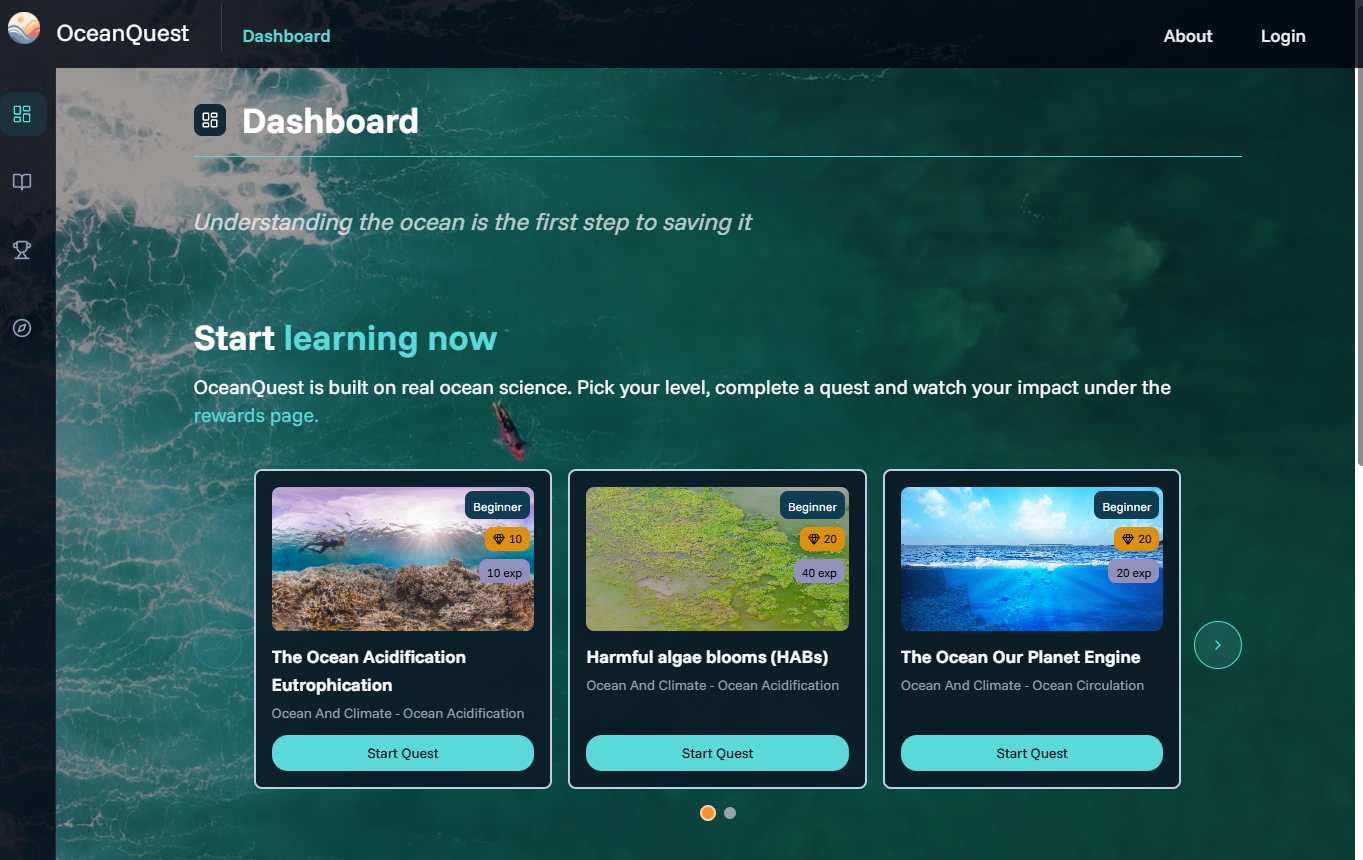
This is where OceanQuest comes in.
The premise is simple to state and hard to build: turn ocean conservation activity into something that can be coordinated, verified, and counted across all five groups simultaneously.
A beach walker logs a quest — say, a stretch of coastline cleaned. That action becomes a data point. The data point feeds a baseline a researcher can use. The same record satisfies a municipality’s reporting need. A company looking to fulfill CSRD obligations can sponsor real, audited activity instead of buying vague offsets.
One activity. Five groups served. No silo crossed manually.
That’s the bet.
It only works if the platform itself is solid — if it’s fast, reliable, accurate, and trustworthy enough that all five groups are willing to depend on it. That’s a real engineering problem, and it’s the one we’ve been spending most of our time on. Production infrastructure on Azure, a CI/CD pipeline that lets us ship fixes the same day they’re reported, a caching layer that keeps the app feeling instant even when traffic spikes. The boring, invisible plumbing.
Because here’s the uncomfortable truth: a coordination platform that goes down on a Saturday morning, when the coastal cleanup crews are out, isn’t a coordination platform. It’s just another silo with a nicer logo.
Where I might be wrong
Maybe the silos exist for a reason. Researchers and municipalities operate on different timescales for legitimate reasons. Companies want CSRD compliance with the minimum coordination cost, not the maximum integration. A platform that tries to merge all of this might be solving a problem each individual group doesn’t actually want solved on those terms.
Maybe coordination isn’t the bottleneck I think it is. Maybe it really is funding, or political will, or something structural that no software layer can touch.
I don’t think any of those are right. But I’ve been wrong before, and the only way to test a thesis like this is to ship it and see whether the people inside those five silos actually pick it up.
So: tell me where I’m wrong. Genuinely.
If we’re right, ocean conservation gets a coordination layer it’s been missing for decades.
If we’re wrong, I’d rather find out from someone working inside one of those silos than from a quarterly report two years from now.