The Romanian Black Sea coast is one of the most dynamic shorelines in Europe.
Over the last four decades, sections of it have retreated by tens of meters. Others have grown — built outward by Danube sediment, shaped by ports and jetties and the slow renegotiation between river and sea.
A 245-kilometre coast with six distinct personalities, each responding differently to the same pressures of climate, infrastructure, and human decision-making.
Most Romanians who’ve stood on those beaches have no idea any of this is happening.
On 30 October 2026, we want to change that.
What are we doing
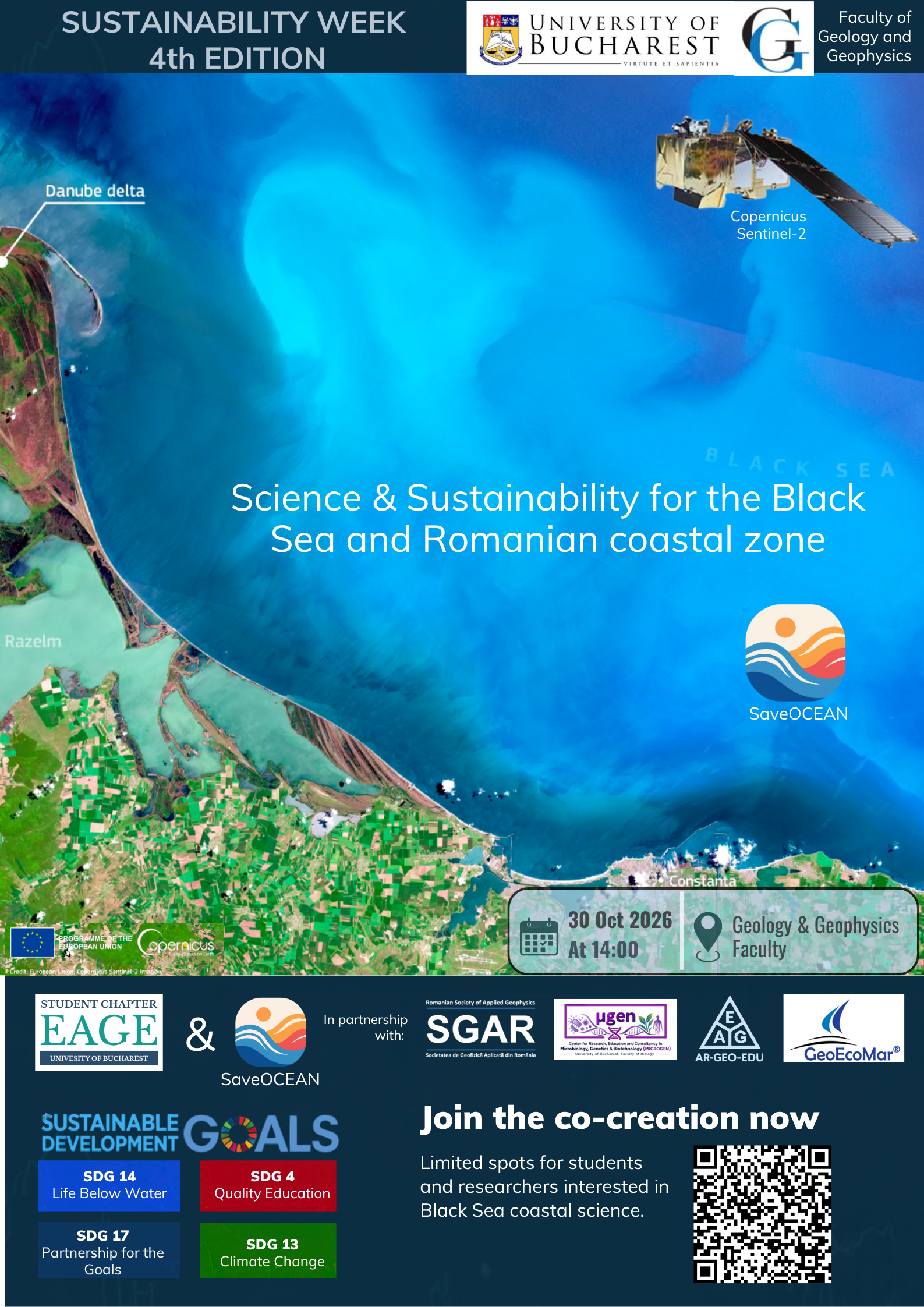
Science and sustainability for the Black Sea and Romanian coastal zone? is a hands-on scientific workshop taking place at the Faculty of Geology and Geophysics at the University of Bucharest, as part of the 4th edition of Sustainability Week.
It’s not a lecture. Students who attend will work as coastal scientists for the day — with real satellite data, real analytical tools, and a real output that goes into scientific review for publication on OceanQuest.
The tools are the same ones professional researchers use: Copernicus Sentinel-2 imagery at 10-metre resolution. Landsat data going back to 1984. QGIS. A 40-year dataset of shoreline positions measured every 50 metres along the entire Romanian coast, built from every usable satellite image since the mid-1980s.
Each student team selects a section of the coast and a mission: figure out what has happened to your stretch of shoreline, prove it with the data, question your own findings, and document it well enough that it could stand up to scientific scrutiny.
Why this matters
The Black Sea is a semi-enclosed sea. It doesn’t flush freely with the open ocean. Pressures accumulate — pollution, sediment disruption, temperature change, development — and they accumulate fast.
The Romanian coast sits at the confluence of all of these. The Danube delta — one of Europe’s most biodiverse ecosystems — meets a coastline shaped by human-made infrastructure, decades of port construction, and a rapidly expanding tourism economy built on the same sandy beaches it’s slowly losing.
Good monitoring data for this coast exists. Copernicus makes it freely available. What has been missing is the human infrastructure to turn that raw data into a growing, structured, publicly accessible evidence base — and to connect the next generation of Romanian scientists to the coast they’ll spend their careers studying.
That’s what this workshop is building toward.

What stundents will take away
More than a method. Every team that completes the five-step workshop framework — Predict, Understand, Explore, Measure, Create — will have produced a full OceanQuest mission.
Those missions go through a review pipeline. If they pass, they publish on OceanQuest as live citizen science content, contributing to what we’re building as a Black Sea coastal module: verified, location-specific, student-produced evidence for a coastline that deserves it.
The beach moved. We’re going to measure it together.

Science and sustainability for the Black Sea and Romanian coastal zone?
- 30 October 2026 at 14:00,
- Faculty of Geology and Geophysics, University of Bucharest — part of Sustainability Week 4th Edition.
Organized in partnership with: SaveOCEAN & EAGE Student Chapter University of Bucharest, in partnership with: SGAR (Romanian Society of Applied Geophysics), AR-GEO-EDU, GeoEcoMar, and MICROGEN.
Registration here