New research from shows why protecting the ocean requires us to measure the whole ecosystem not just one solution.
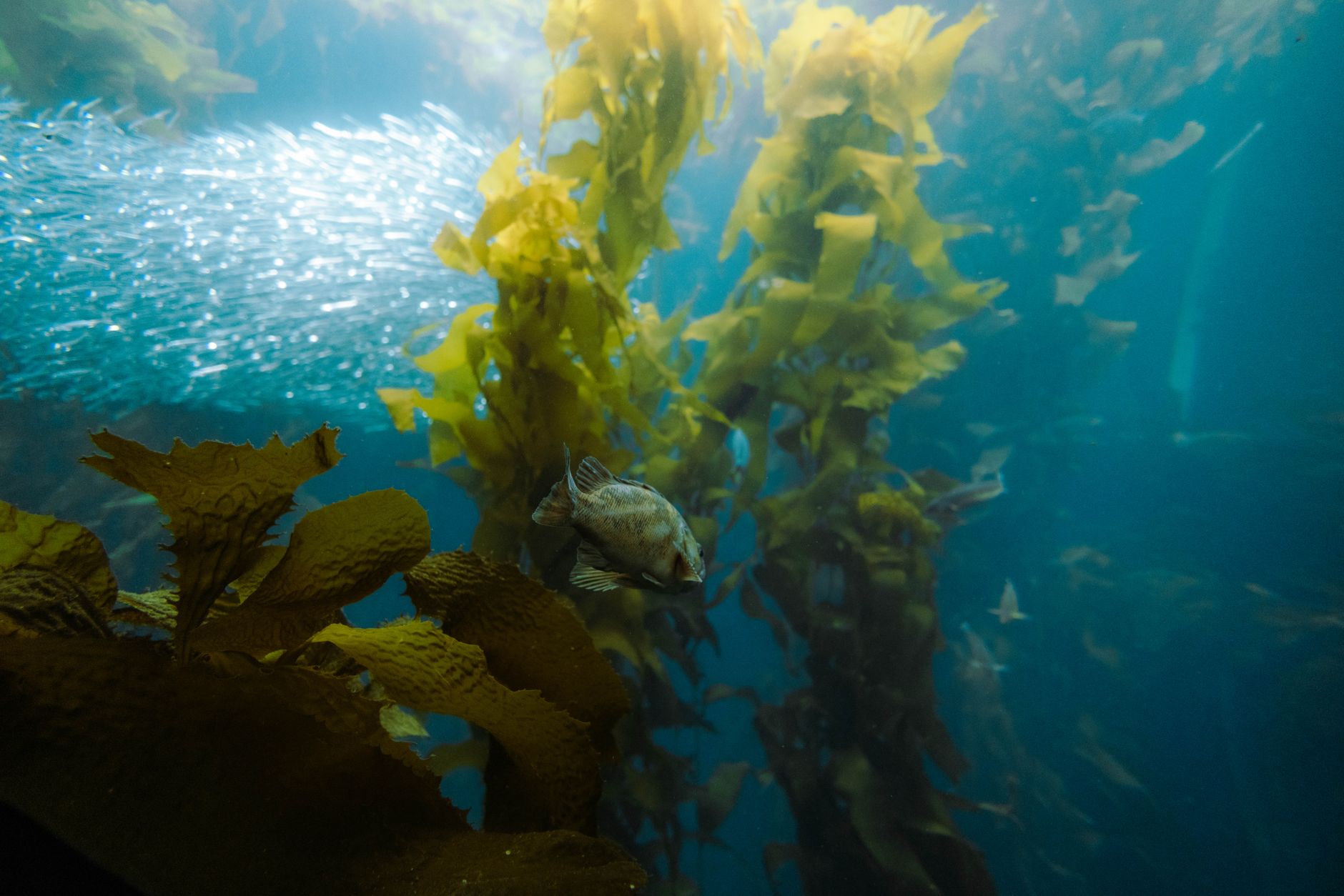
Seaweed is increasingly being discussed as one of nature’s potential allies against climate change.
It grows quickly.
It absorbs carbon dioxide during photosynthesis.
And in coastal waters, that biological activity can temporarily increase seawater pH.
That has led to an exciting idea:
Could seaweed farms create local refuges where corals and shell-forming organisms are partially protected from ocean acidification?
A newly published 2026 study from a coral reef in Onna, Okinawa, Japan, suggests the answer may be yes — but with an important warning.
The ocean is rarely controlled by one variable.
And if we want to understand whether nature-based solutions truly work, we need to measure the entire system.
First: why does ocean acidification matter?
The ocean absorbs a significant part of the carbon dioxide released into the atmosphere.
This helps slow atmospheric warming, but it comes at a cost.
When CO₂ dissolves into seawater, it changes the ocean’s carbonate chemistry and lowers pH — a process known as ocean acidification.
For organisms that build shells or skeletons from calcium carbonate, including corals, oysters, clams and some plankton, these chemical changes can make growth and maintenance more difficult.
Coral reefs are particularly vulnerable because they are already facing multiple pressures at once:
- ocean warming
- bleaching
- oxygen loss
- pollution
- physical disturbance
- acidification
So scientists are increasingly asking whether natural processes could create small local refuges where conditions are temporarily more favourable.
Seaweed is one candidate.
The idea: let photosynthesis change the chemistry
During daylight, seaweed removes dissolved CO₂ from seawater through photosynthesis.
When CO₂ decreases, local seawater pH can increase.
In principle, a sufficiently productive seaweed farm located near corals could therefore create a temporary zone of less acidic water.
Previous research has observed this effect around seaweed farms.
But there is a problem.
Most studies compare sensors inside and outside a farm. That tells us what is happening at those specific points.
It doesn’t necessarily tell us:
- How far does the effect travel?
Or:
- Was the seaweed actually responsible?
That is what makes the Okinawa study particularly interesting.
A natural laboratory in Okinawa
Researchers studied a roughly 3-kilometre-long reef system in Onna-son, Okinawa.
The area contains coral reefs, natural algae, seagrass and substantial seaweed cultivation.
The dominant cultivated species is Mozuku, a brown seaweed widely consumed in Japan.
During the spring 2023 growing season, cultivation covered approximately 0.16 km² — about 8% of the surveyed area — and produced 585 tonnes of seaweed.
Scientists surveyed the reef during:
🍂 Fall
❄️ Winter
🌱 Spring
They collected seawater samples across the reef in both the morning and afternoon and analysed variables including:
- pH
- dissolved inorganic carbon
- total alkalinity
- dissolved oxygen
- temperature
- salinity
But they also measured something equally important:
- the movement of the water.
Currents, waves, tides and water depth were monitored because biology does not operate independently of physics.
And this turned out to matter enormously.
What did they find?
During afternoon measurements, reef water frequently had a higher pH than offshore water.
The researchers observed elevated reef pH during approximately:
- 77–100% of afternoon observations in fall
- 53% in winter
- 75–92% in spring
At some locations, pH increases reached roughly +0.10 to +0.13 units relative to offshore water.
Spring — when Mozuku cultivation was at its largest — also showed the strongest changes in carbon chemistry.
At first glance, this seems like strong evidence that the seaweed farm was creating an acidification refuge.
But then the researchers looked at the rest of the environmental data.
And the story became more complicated.
The invisible variable: how long does the water stay?
During spring, the reef also experienced:
- slower currents
- smaller waves
- lower mean sea level
These conditions increase what scientists call water residence time.
In simple terms: The water stays in the reef system longer.
And the longer seawater remains in contact with photosynthesising organisms, the more time those organisms have to modify its chemistry.
Imagine adding a drop of dye to two rivers.
In a fast-moving river, the colour disappears almost immediately.
In a quiet lagoon, it can remain concentrated for much longer.
The same principle applies to the chemical influence of seaweed.
A farm producing a strong biological effect may have very little impact downstream if currents rapidly replace the water.
And the farm wasn’t the only seaweed
There was another complication.
The reef already contains natural macroalgae.
Researchers observed comparable pH increases during fall, when cultivated Mozuku was not present at its spring maximum.
That suggests natural reef vegetation can potentially create similar chemical effects.
The scientists therefore could not conclude that the seaweed farm alone caused the elevated pH.
Instead, the observed chemistry resulted from a combination of:
🌿 cultivated seaweed
🌱 natural algae
🪸 reef metabolism
☀️ photosynthesis
🌙 respiration
🌊 waves
➡️ currents
🌡️ seasonal conditions
This is perhaps the most important result of the entire study.

Nature-based solutions need context
It is tempting to look for simple environmental solutions.
- Plant seaweed.
- Absorb carbon.
- Raise pH.
- Protect coral.
But ecosystems rarely behave like controlled laboratory experiments.
The study does not say that seaweed aquaculture cannot help mitigate local ocean acidification.
In fact, it confirms that meaningful daytime pH increases can occur across reef environments.
What it shows is something more valuable:
The effectiveness of a nature-based solution depends on where, when and under what environmental conditions it is deployed.
A seaweed farm located in slow-moving water may create a measurable local chemical footprint.
The same farm in a highly energetic environment may have a very different effect.
And natural habitats nearby may already be providing similar ecosystem functions.
This is why ocean monitoring matters
At SaveOCEAN, this research highlights something we believe is essential:
- Environmental action needs environmental evidence.
- If we only measure the seaweed, we miss the current.
- If we only measure pH, we miss the waves.
- If we measure at one location, we may miss what is happening 500 metres away.
- And if we measure only once, we may mistake a temporary condition for a permanent effect.
Understanding coastal ecosystems requires us to connect multiple types of information:
biology + chemistry + ocean physics + time + location.
This is where sensors, citizen science, autonomous monitoring, satellite observations and increasingly AI-assisted analysis can become incredibly powerful.
Not because technology replaces ecology. But because technology helps us see ecological relationships that would otherwise remain invisible.
From “Did it work?” to “Why did it work?”
Perhaps the most important shift in ocean conservation is moving away from simply asking:
Did this intervention work?
toward asking:
Where did it work?
For how long?
Under which conditions?
What else contributed to the result?
Can we repeat it somewhere else?
That is how nature-based solutions become measurable rather than aspirational.
And it is how projects such as seaweed restoration, seagrass recovery, coral restoration and blue-carbon initiatives can become increasingly evidence-driven.

The ocean is a system, not a collection of variables
A seaweed farm doesn’t exist separately from its reef.
A coral doesn’t experience pH separately from temperature.
A current doesn’t move independently of tides and waves.
Everything interacts.
That complexity can make ocean science difficult.
But it is also what makes the ocean extraordinary.
The lesson from Okinawa isn’t that seaweed farming is or isn’t the answer.
It is that the answer depends on understanding the ecosystem around it.
And the better we observe the ocean, the better our chances of protecting it.
- Measure more.
- Understand more.
- Protect better.
Because meaningful ocean action begins with knowing what is actually happening beneath the surface.

Read more here.
Kekuewa, S.A.H., Rintoul, M.S., Courtney, T.A. et al. Seasonal Reef-Scale Variability in Seawater CO₂ Chemistry in the Presence and Absence of Seaweed Cultivation in Onna, Okinawa, Japan. Estuaries and Coasts 49, Article 168 (2026). Published 27 July 2026.