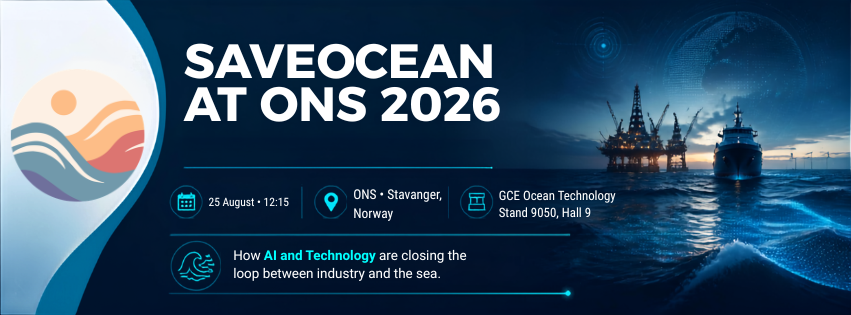
How AI and technology are closing the loop between the industry and the sea — live at the Energy Cluster Norway stand, Tuesday 25 August, 12:15.
This August, SaveOCEAN heads to Stavanger. We are joining GCE Ocean Technology at ONS 2026 — and we are bringing the ocean technology with us.
ONS 2026 is one of the largest energy events. Thousand industry leaders, engineers, investors, policymakers, and innovators descend on Stavanger every two years to discuss about where the world’s energy is going and what it will take to get there.
This year’s theme is Courage — addressing geopolitics, energy security, and the climate in the same breath. And with that we celebrate a milestone for the Norwegian cluster landscape: GCE Ocean Technology, Energy Transition Norway and Energy Valley are joining forces as Energy Cluster Norway — three strong, complementary clusters uniting as one national force for energy innovation. The new cluster launches officially at the stand on Monday 24 August, alongside more than 30 presentations from cluster players on the future of energy.
We have never attended ONS as a presenter before. This year, Aurelia Paraschiv will be on stage at the GCE Ocean Technology stand — Stand 9050, Hall 9 — to present:
“Ocean Action. Audit Proof. How AI and Technology are closing the loop between the industry and the sea.”
Lets us explain you why that title matters, and why we think the conversation happening at ONS needs to include what we’re building.Lets us explain you why that title matters, and why we think the conversation happening at ONS needs to include what we’re building.
Why is an ocean organisation at an energy conference?
Because there is no energy transition without the ocean. Offshore wind is built in it. CCUS stores carbon under it. Seabed minerals are debated on its floor. Hydrogen and batteries will move across it. And every one of those activities needs something that barely exists today: open, verifiable, real-time data about ocean health.
That is what SaveOCEAN builds. Open dashboards, AI-driven monitoring and field-ready tools — so that companies, regulators and communities can see what is happening with the ocean and act on it. For the energy sector, that is not a nice-to-have: with CSRD reporting now demanding credible water and marine impact data, audit-ready ocean intelligence is becoming financial infrastructure.

The Energy Industry and the Ocean Are More Connected Than the Industry Admits
ONS is primarily an energy conference. Oil and gas. Offshore wind. Hydrogen. CCUS. The ocean is the backdrop — the place where the platforms sit, where the cables run, where the fish used to be. It is not typically where the sustainability conversation starts.
But that framing is changing fast, and with the help of the regulations and verified proof this can change to a positive impact.
The companies operating in the North Sea, the Norwegian Continental Shelf, and offshore fields globally are now required — under the EU’s Corporate Sustainability Reporting Directive — to report verified data on their impacts on marine biodiversity, their resource use, and their waste flows. ESRS E4 covers biodiversity and marine ecosystems. ESRS E5 covers circularity and resource use. Both require site-level, traceable, externally assured data. Not estimates. Not proxies. Evidence.
And almost none of the companies in this industry have the tools to produce that evidence at the quality auditors now require.
That is the gap we are closing.
What “Closing the Loop” Actually Means
The energy industry has spent decades developing extraordinary technology for monitoring what happens beneath the seabed — seismic sensors, ROVs, subsea monitoring systems that cost millions and run continuously. But monitoring what happens because of operations — to species, to habitats, to the ecosystems that absorb the environmental cost of energy extraction and production — has been an afterthought.
OceanQuest changes that. Not by replacing the science, but by making the verification of ocean action automatic, cryptographically signed, and audit-ready from the moment it occurs.
AI does the work of connecting the data points — from field observation to circularity score to annual sustainability report — that currently takes sustainability teams 50 to 80 hours a year in spreadsheets. And it does it in a way that an auditor can verify, an investor can trust, and a regulator cannot reject.
That is what closing the loop looks like. The industry’s environmental footprint creates an obligation. The obligation requires verified data. The verified data enables better decisions, unlocks nature finance, and — over time — produces a measurable improvement in the health of the ocean the industry depends on.

Why ONS, Why Now
The Courage theme resonates with me more than I expected.
It takes a certain kind of courage to stand in a room full of energy executives and say: the ocean you operate in is degrading, and the data to prove it — and to prove that you are doing something about it — needs to exist, and it needs to be verifiable. Not because it makes a good sustainability report. Because without that data, capital cannot flow to restoration, science cannot track recovery, and the regulatory pressure will only intensify while the ocean continues to decline.
The offshore energy industry has the engineering capability, the computational infrastructure, and increasingly the regulatory incentive to lead on this. We are not asking for a transformation of business models. We are offering a tool that makes ocean accountability as automatic and auditable as any other operational data stream.
That conversation has a place at ONS. We intend to have it.
Come Find Us
If you are attending ONS this week, I would love to speak with you — before, during, or after the presentation. Whether you work in sustainability, in operations, in finance, or in any part of the offshore value chain that touches the sea, there is something in this conversation that is relevant to you.
When: Tuesday 25 August, 12:15 Where: GCE Ocean Technology Stand 9050, Hall 9 — right beside the Centre Court Presentation: Ocean Action. Audit Proof. How AI and Technology are closing the loop between the industry and the sea
And if you cannot make it to the 12:15 slot, we will be at the GCE Ocean stand the remaining of the day. Stop by, say hello, and let’s talk about the ocean — the one that is right outside the walls of the Stavanger Exhibition Centre, and the one that needs us to start taking it seriously.
See you in Stavanger.
Aurelia Paraschiv, ceo@saveocean.net